



 OKPOLICY.ORG
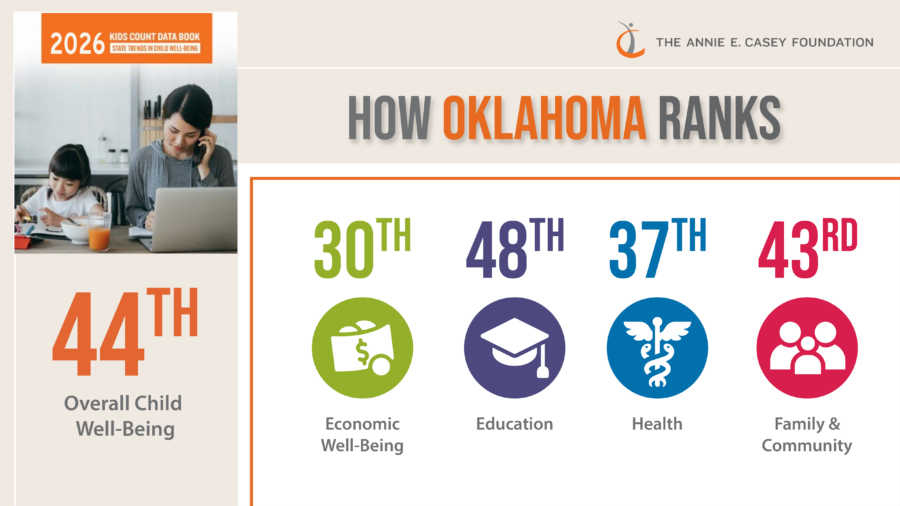
Oklahoma continues to rank among the bottom 10 states for overall child well-being in the 2026 KIDS COUNT® Data Book, 50-state report of recent data developed by the Annie E. Casey Foundation analyzing how kids are faring nationwide.
For the 2026 KIDS COUNT® Data Book, Oklahoma tied with Texas for 44th overall for child well-being, with only Nevada, Alaska, Louisiana, New Mexico, and Mississippi ranking lower. Oklahoma’s individual rankings on major categories were:
-
- 30th in economic well-being
- 37th in health,
- 43rd in family and community, and
- 48th in education (ahead of only Alaska and New Mexico).
Oklahoma ranked among the top half of all states in only three of the report’s 16 indicators. The data show Oklahoma leaders must do more to invest in the well-being of Oklahoma children and families, including proven programs and services that can help them thrive.
For the first time this year, states receive a comprehensive score (from 0 to 1,000) in the Data Book, not just a ranking. The scores track 16 indicators in four domains — economic well-being, education, health, and family and community factors — over a five-year period from 2019 to 2024.
The new scoring system shows whether policies and public investment are actually improving children’s lives, not merely how states compare to each other. Oklahoma received an overall score of 425, which was 122 points below the national score of 547.
Oklahoma’s lowest score in the education domain (126 out of 1,000, ranked 48th). While the state’s highest score was in the economic well-being domain (556 out of 1,000, ranked 30th), nearly 1 in 5 Oklahoma children continue to live in poverty. Oklahoma scored below the national average in all four domains.
The report includes a comprehensive analysis of all 50 states across multiple domains of child- and family well-being. Among the 16 components of the report, Oklahoma ranked among the top half of all states in only three indicators: teens not attending school and not working (6%, ranked 15th); children in households that spend more than 30% of their income on housing (26%, ranked 23rd), and percent of low-birthweight babies (8.2%, ranked 23rd).
By contrast, the state ranked 40th or below on seven of 16 indicators:
- Percent of children in poverty, which for a family of two adults and two children was below $30,900 in 2023 (19%, ranked 42nd)
- Percent of 4th graders who scored below proficient reading level (77%, ranked 48th)
- Percent of 8th graders who scored below proficient math level (83%, ranked 49th)
- Percent of high school students not graduating on time (18%, ranked 41st)
- Children without health insurance (9%, ranked 46th)
- Child and teen death rate (35 deaths per 100,000 children ages 1 to 19, ranked 40th)
- Teen birth rate (20 births per 1,000 females ages 15 to 19, ranked 45th)
“Year after year, Oklahoma leaders talk about making our state stronger and more prosperous, but these rankings show our priorities still don’t match our rhetoric,” said Carly Putnam, Policy Director and KIDS COUNT coordinator for the Oklahoma Policy Institute, Oklahoma’s member of the Casey Foundation’s KIDS COUNT network.
“Our lawmakers and elected officials somehow always seem to find urgency when it comes to tax breaks and incentives for wealthy individuals and corporations, yet Oklahoma continues to rank near the bottom when it comes to investing in the health, education, and stability that children need to thrive,” Putnam said.
In its 37th year of publication, the KIDS COUNT® Data Book provides reliable statewide numbers to help leaders see where progress is being made, where greater support is needed and which strategies are making a difference. OK Policy encourages lawmakers and officials in Oklahoma to use this detailed information to unite across party lines and respond with initiatives that invest in young people. By offering a local road map, the Data Book equips policymakers, advocates and communities with the information they need to make decisions that help kids and young people thrive.
“This year’s KIDS COUNT results should be a wake-up call for every community in our state. If we want a stronger Oklahoma tomorrow, we have to be willing to invest in Oklahoma kids today with the same energy and commitment that we show toward protecting wealth at the top,” Putnam said.
###
RELEASE INFORMATION
The 2026 KIDS COUNT Data Book will be available at www.aecf.org/databook. Additional information is available at www.aecf.org/databook. Journalists interested in creating maps, graphs and rankings in stories about the Data Book can use the KIDS COUNT Data Center at datacenter.aecf.org.
ABOUT THE ANNIE E. CASEY FOUNDATION
The Annie E. Casey Foundation creates a brighter future for the nation’s young people by developing solutions to strengthen families, build paths to economic opportunity and transform struggling communities into safer and healthier places to live, work and grow. For more information, visit www.aecf.org. KIDS COUNT is a registered trademark of the Annie E. Casey Foundation.
ABOUT THE OKLAHOMA POLICY INSTITUTE
The Oklahoma Policy Institute seeks to create a more equitable Oklahoma through its nonpartisan policy research, analysis, and advocacy. OK Policy encourages critical conversations through data-driven research and outreach regarding state policy so that every Oklahoman has equitable opportunities to thrive. okpolicy.org