



 OKPOLICY.ORG

This article was co-authored by Gabriela Ramirez-Perez, Immigration Policy Analyst and Polina Rozhkova, Data Analyst.
• See also, Six reasons Oklahoma shouldn’t allow private prisons to reopen as immigration detention centers
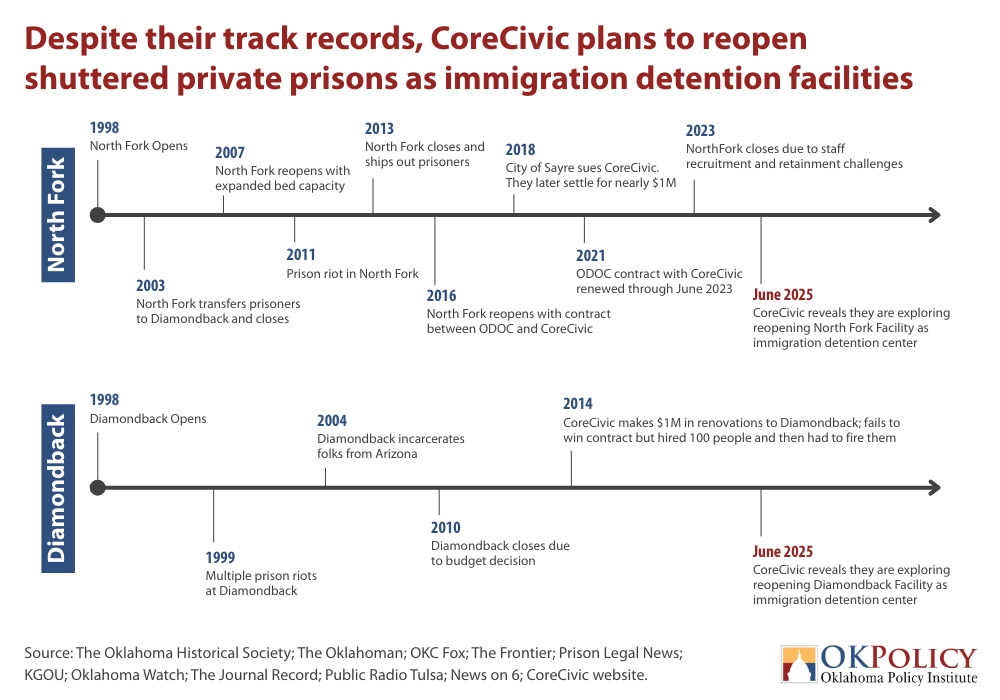
Business with CoreCivic and the GEO Group, profit-driven correctional corporations, has historically not gone well for Oklahoma. In the late 1990s and early 2000s, CoreCivic opened the Diamondback Correctional Facility in Watonga and the North Fork Correctional Facility in Sayre, becoming the largest local employer and turning these communities into “prison towns.”
Yet, this economic stability was short-lived, with the prisons closing every few years, sometimes abruptly, over the last two decades. Based on job postings, it appears CoreCivic is now actively pursuing contracts to reopen facilities as immigration detention centers in the cities of Watonga and Sayre; however, there’s no evidence suggesting this time will be different.
Facilities run by CoreCivic and the GEO Group have been the sites of human rights violations across the country, including in Oklahoma. Reports include deaths that went undetected for days, multiple violent riots, and contract violations — including nearly $1 million CoreCivic owed the City of Sayre in unpaid fees, resulting in a lawsuit the company eventually settled. These are just some of the reasons Oklahoma decided to move away from private prisons, culminating in the termination of the state’s last private prison contract this year. Despite this track record, these same companies are now being offered a taxpayer-funded reward created by the sweeping federal reconciliation bill.
CoreCivic CEO Damon Hininger is calling this wave of funding a “catalyst for company growth.” While reopening these prisons as detention centers may maximize shareholder value, it does so at the expense of the communities in which they operate. There is no evidence that these facilities will benefit small town residents economically, socially, or in terms of public safety. It is also important to be clear about who is being detained. Three in four people booked into U.S. Immigration and Customs Enforcement (ICE) custody this year had no criminal convictions beyond a traffic or immigration-related offense. Fewer than one in ten were convicted of serious crimes like assault, robbery, or murder. These statistics indicate that public safety is not the goal of these actions. Instead, they are being carried out to advance a nationalistic agenda – and it’s companies like CoreCivic and the GEO Group that stand to profit from it.
Immigration detention is unnecessary and counterproductive
Forcing small towns like Watonga and Sayre to play host to privately managed facilities, despite their record of dehumanizing conditions, in exchange for jobs and tax revenue, is exploitative and predatory. It is also entirely unnecessary. For many years, officials have justified immigration detention by claiming it is “for the safety of the community and to ensure that immigrants appear for their legal hearings.” Still, the reality is that immigration detention harms both individuals and public safety. Evidence shows that detaining immigrants can reduce crime reporting, does not deter migration, and appears to be ineffective in reducing crime. Further, the vast majority of immigrants show up to their court hearings: more than 80 percent of non-detained people attend all scheduled hearings.
Additionally, people who are in detention can face a wide range of harm, from severe emotional distress to dangerously unsanitary conditions, including reports of overflowing toilets, people unable to shower for over a week, and a lack of clean underwear. Such conditions have also resulted in preventable deaths due to medical neglect or suicide. Keeping people in horrible conditions neither promotes community safety nor ensures immigration court appearances. Instead, it simply inflicts needless harm on thousands of people — most with no criminal record — who would have otherwise attended their court hearing. Yet, the corporations that own these facilities are poised to bring in record profits, even at the cost of human suffering.
Private immigration detention facilities exploit taxpayers and incarcerated people to rake in profits
The federal reconciliation bill passed earlier this summer allocates an unprecedented $170 billion for immigration and border enforcement; $45 billion of that is specifically set aside for expanding detention facilities to meet President Trump’s goal of deporting one million people by the end of the year. That $45 billion is more than the annual budget of every local and state law enforcement agency in the country combined. This makes ICE the largest police force in the country, meaning the biggest beneficiaries of the investment are not local law enforcement agencies or residents, but CoreCivic and the GEO Group.
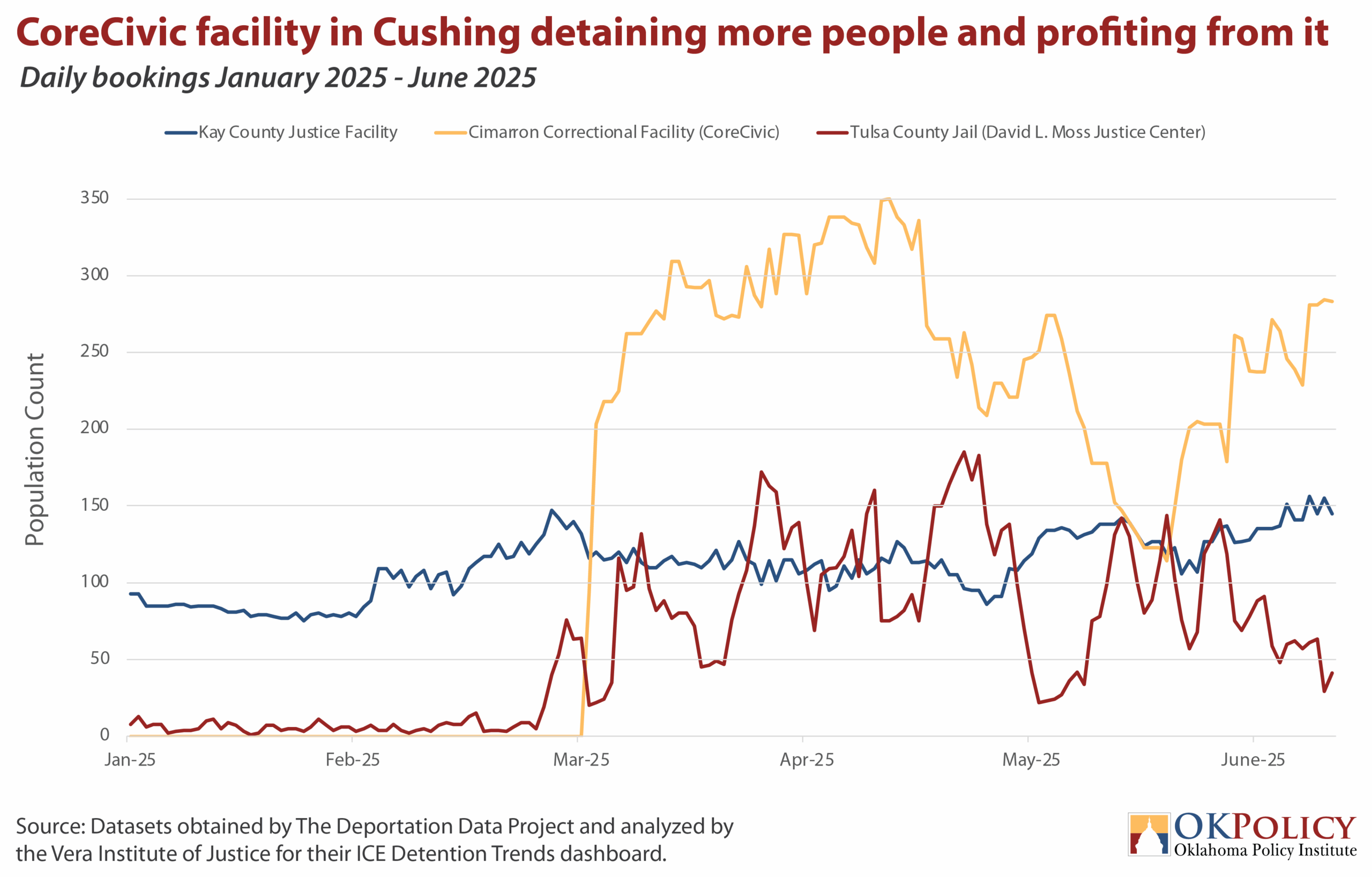
Their revenue relies on detention beds being filled, as their annual reporting to the SEC makes clear. CoreCivic is estimated to earn an additional $1.5 billion in revenue from the expanded detention capacity. Detention, at least for now, serves as an intermediate step to deportation. The Trump administration’s push for mass deportations, therefore, demands an increase in detention space. In Oklahoma, this is especially challenging: the state’s prisons operate at 90 to 100 percent capacity, and the few local jails with available space — such as in Tulsa and Kay counties — are already holding detainees for ICE.
In 2023, the City of Cushing and CoreCivic entered into an agreement that would allow the corporation to use a portion of the beds at the nearby Cimarron Correctional Facility (the site of the deadliest prison riot in Oklahoma’s history) to house people ICE has detained. However, publicly available data shows no people held there until this year. At the beginning of 2025, CoreCivic expanded its Cimarron contract to open a larger portion of its 1,600 beds to hold additional ICE detainees; approximately 130 people detained were there as of the first week of August.

CoreCivic’s expansion in Oklahoma creates far too many harms for very little short-term gain
As corporations expand their detention capacity, Oklahoma has emerged as a prime target for reopening former private prisons as private detention centers. Research has shown that private prisons do not improve public safety or reduce recidivism, yet local governments are incentivized to accept them because of the economic investments the corporations promise. Many small towns, particularly in rural areas, come to rely on private prisons for job creation and city revenue. Currently, the City of Cushing’s general fund receives $1.02 per day for each person housed in CoreCivic’s Cimarron Correctional Facility.
However, these economic perks come with severe drawbacks. When a private detention center opens in a small town, it hinders economic growth and diverts resources away from local residents. Oklahoma’s own history with these for-profit institutions shows that after a facility inevitably closes — often due to challenges with recruiting and retaining staff — the town is left to pick up the pieces, having lost a significant source of revenue and their largest local employer.

Corporations in the prison industry exploit communities and cause lasting harm for short-term profit
Oklahoma recognized the adverse effects of private prisons, and our state leaders have ended prison contracts with these companies. However, the push for mass deportations and detention facility expansion threatens the progress we’ve made, most recently with the state buying the Lawton Correctional Facility, thereby ending the last private prison contract in Oklahoma.
CoreCivic’s recent earnings call suggests plans to reopen other shuttered private prisons in Sayre and Watonga, with the public in Watonga reporting many recent upgrades to the empty Diamondback facility. In addition to job postings on CoreCivic’s website, the city manager of Sayre confirmed that the company has inquired about a space to conduct job interviews. However, CoreCivic has been known to hire people before securing a contract — only to fire them — as was the case in Watonga in 2014, when the company was known as Corrections Corporation of America.
As a private corporation, CoreCivic’s primary purpose is to maximize shareholder value, not to make our communities safe. In fact, company officials cite negative publicity, local resistance, and decreases in “occupancy” as risk factors that could reduce the company’s profitability. Small towns should not be forced to tolerate human rights violations in exchange for economic investments that can vanish the moment shareholder interests shift. Local residents in neighboring Kansas, including former CoreCivic employees, are pushing back against CoreCivic’s cash grab and the harms it has created in their communities. We must do so as well.
Ways to take action
As public talk of reopening CoreCivic’s “previously idle facilities” continues, quieter conversations may be unfolding in your city commissioners’ meetings, as was the case in Cushing. City council meetings are good venues for making your voice heard. You can also contact your city officials directly to share your concerns.
If you are a resident of Watonga or Sayre, you can attend your local city council meeting to make your opinions heard.
- Watonga City Council meets at 6:00 pm at least once a month, with dates posted on their website.
- Sayre City Council meets at 7:00 pm on the third Tuesday of every month.