




 OKPOLICY.ORG
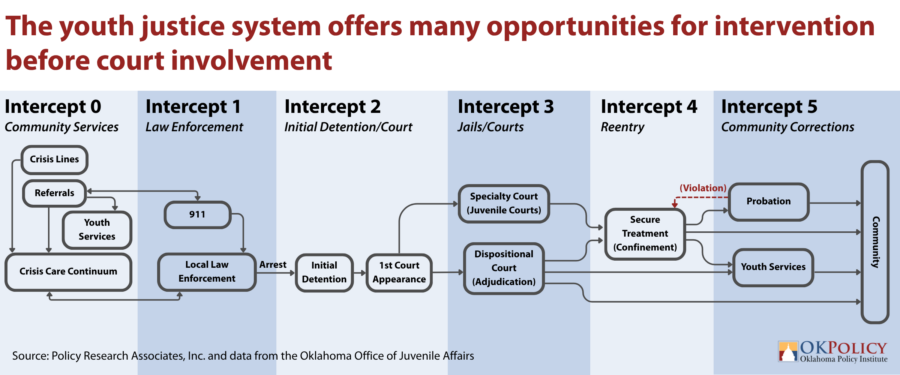
Oklahoma’s youth justice system is tasked with ensuring youth who cause harm face fair consequences, but is also responsible for protecting children and promoting long-term public safety. One of the most effective ways to do both is by setting a reasonable minimum age of adjudication at 12 years old, like Senate Bill 2097 proposes. Adjudication is the court process for determining if children can be held criminally responsible, or delinquent, in court, shown at Intercept 3 in the diagram below.
Children’s brains, judgment, and emotional regulation are still developing , so subjecting them to court proceedings and incarceration does little to improve outcomes for them — and it impedes on their rights. Putting kids under 12 through court involvement places unnecessary strain on public systems while failing to address the unmet needs that can lead to harmful behavior.
Setting a reasonable minimum age for adjudication means Oklahoma can reduce strain on our systems while meeting children’s underlying needs
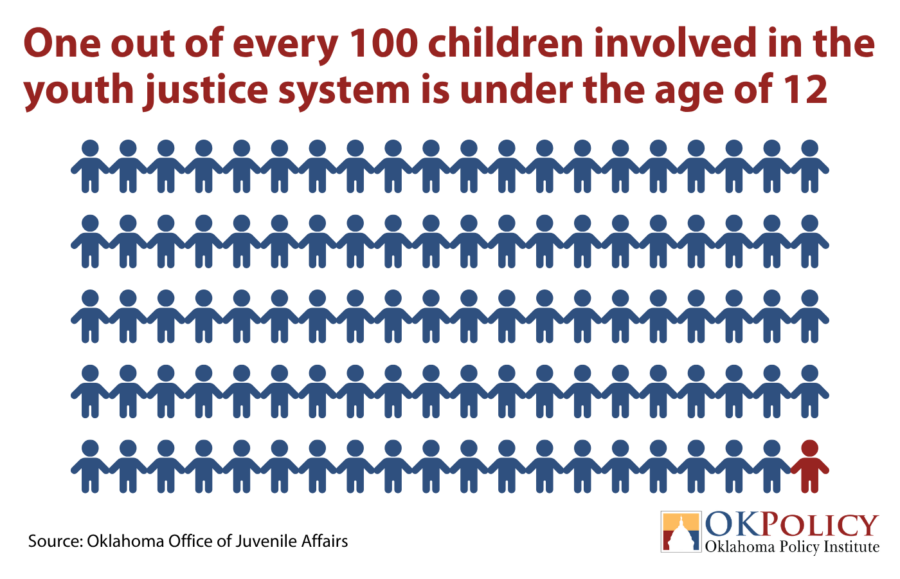
While children under 12 make up a relatively small portion of Oklahoma’s youth justice population, their system involvement requires disproportionate time and resources, often without producing meaningful outcomes. This government inefficiency is due to the issue of competency to stand trial, which is the idea that one must meaningfully understand the court process and consequences as it is happening to them.
Developmental science is clear: youth evaluated for competency at age 12 and under are unlikely to develop the necessary maturity within a reasonable timeframe to be deemed competent to stand trial . This means that when children under 12 are evaluated for competency to stand trial, their cases are unlikely to result in an eventual adjudication due to developmental immaturity. In practice, this means that court involvement for children under 12 turns into a costly and time-consuming process that leads nowhere.
Since 2016, only 17 children under 12 in Oklahoma have been referred for competency evaluations, according to data acquired from the Oklahoma Commission on Children and Youth . However, in every case where a referral was made, the child was found incompetent to stand trial. These numbers do not capture cases in which competency evaluations were never requested. There are many reasons an attorney may not pursue a competency evaluation for a child they represent, including the fact that competency proceedings for youth are still a relatively new process in Oklahoma and therefore likely underutilized. This suggests that some children may be pushed through the court process despite being legally unable to understand or participate in it.
Competency to stand trial is not an optional aspect of our court systems: it is a right guaranteed by the U.S. Supreme Court . Continuing to adjudicate children who are developmentally incapable of meeting this standard undermines due process while draining public resources. Establishing a minimum age of adjudication at 12 years old would allow Oklahoma to focus on services that actually meet children’s needs rather than funneling them into a system ill-equipped to help them.
Locking up young kids and pre-adolescents harms them and public safety
Rather than deterring or reducing adverse behavior in children, incarceration makes youth highly likely to reoffend. Based on available studies of youth released from residential corrections programs, 70-80 percent of youth are rearrested within two or three years . When examining both residential treatment and court involvement, both may actually increase the likelihood of reoffense compared to probation . This means that the decision to adjudicate a child could actually further harm public safety. Detention centers are often not a safe place for young children , and those experiences pile onto existing trauma that youth experience prior to entering the justice system.
When examining those who become involved in the justice system as adults, they have much higher rates of adverse childhood experiences (ACEs) . This means they suffered higher rates of childhood trauma than the general population, including emotional and physical neglect. While high ACE scores in the U.S. are relatively common, higher ACE scores present a significant risk factor for juvenile system involvement . A higher prevalence of ACE scores in the youth justice system suggests that we may not have enough adequate treatment options available for youth who have experienced trauma before they enter the justice system.
Oklahoma is currently experiencing a shortage of workers in the behavioral health workforce , which means it cannot afford to retraumatize youth by incarcerating them. Interventions like detention or long term residential treatment in the youth justice system are not proven methods of deterring unwanted behavior. Noting this, it’s important to turn to solutions that keep youth in their communities and at home with their families while treating underlying mental health problems.
Young children need to be connected to age-appropriate services in the community, not court
Mental health alternative-first responses that involve mental health units rather than the police are working, but have not been implemented statewide . They also are not sufficiently meeting all the mental health needs of Oklahomans, especially youth, which means that police are often put in the middle of mental health crises that community members experience. Police involvement is often the first step that initiates the process for further justice system involvement.
The systems that are meant to respond to youth in crisis in Oklahoma are failing — 65-70 percent of youth who encounter the justice system meet the criteria for a diagnosable mental health issue . The systems that are supposed to support youth mental health needs fail before youth ever enter the justice system. Youth need services that are responsive to their needs in their community, like functional family therapy or other family-centered services that emphasize meeting underlying needs while providing support for families. Emphasizing services like these means that entering the youth justice system can be a pathway for families, rather than a punishment for young people.
Establishing a minimum age of adjudication at 12 years old is not about ignoring harm — it is about responding to it in smarter, more effective ways
Oklahoma has both a moral and constitutional obligation to treat children in ways that reflect their developmental capacity and long-term potential. By setting a reasonable minimum age for adjudication, Oklahoma can protect children’s rights, strengthen public safety, and redirect limited resources toward community-based, trauma-informed services that address the root causes of harmful or destructive behavior in children. If the goal of Oklahoma’s youth justice system is to improve outcomes for children and communities, then a clear minimum age of adjudication is a necessary and responsible step forward.