



 OKPOLICY.ORG
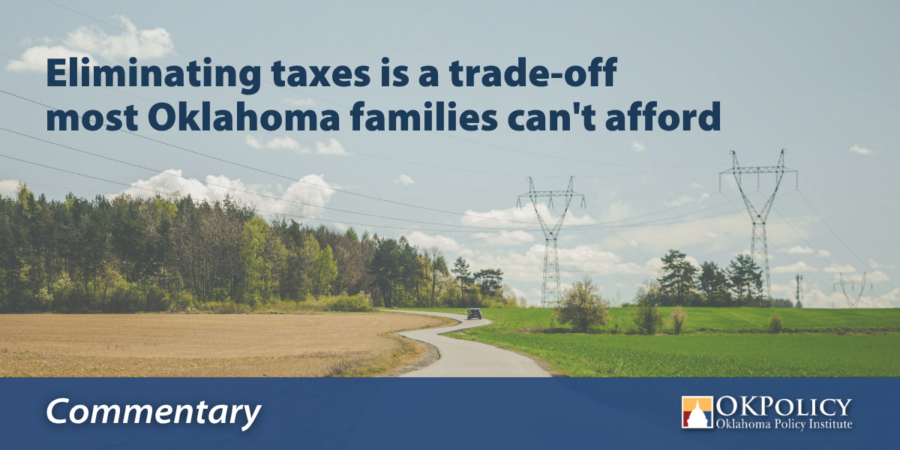
The promise sounds simple enough: eliminate taxes and let people keep more of what they earn. No property taxes. No income taxes. No April deadlines. More money in your pocket.
But when taxes disappear, everyday life doesn’t stay the same. It changes fast — and the damage is hard to undo.
Start with the basics people rely on without thinking about it.
- Schools fade or close. Public schools educate most children in this country, and they run on shared funding. Without it, only families who can pay for private school have real options. And forget about rural communities, where private schools aren’t even an option. When we undercut public education, everyone else gets left behind. That hurts the whole economy, not just individual families.
- Roads and bridges fall apart. Without maintenance, streets crack and bridges weaken. Some roads get replaced by toll roads. Others just get ignored. Getting around becomes slower, costlier, and more dangerous.
- Public safety becomes a question mark. Police, firefighters, and paramedics all run on public funding. Without it, response times get longer — or those services disappear completely. When something goes wrong, help is no longer a sure thing.
- Courts and the justice system weaken. A fair legal system costs money to run. Without shared funding, justice can start to depend more on who can afford a lawyer than on what’s actually right.
- Food and medicine become less safe. Inspections and safety standards don’t run themselves—they require funding and staff. Without them, contaminated food, unsafe drugs, and preventable illness become more common.
- Neighborhood stability erodes. Building codes, zoning rules, and fire protection systems help keep communities safe and livable. Without them, homes can be built unsafely, dangerous businesses can move in next door, and small problems can quickly become disasters.
- Public health protections weaken. Vaccination programs, disease tracking, and emergency preparedness depend on shared funding. Without them, outbreaks spread faster and hit harder.
Taken together, this isn’t a list of minor inconveniences. It’s a picture of what daily life becomes. Without shared investment, society stops feeling like a community and starts feeling like every person fighting for themselves.
That’s the tradeoff often left out of the conversation.
Some Oklahoma lawmakers continue to push for eliminating major taxes, saying it’s relief for everyday people. And sure, taxes are frustrating — especially when not everyone is paying their equal share. But the essential services that they fund are easy to take for granted, right up until it disappears.
Taxes are more than a bill we pay. They are the price of belonging to a community.
They are how we pool our resources to build the things none of us can build alone: schools that prepare the next generation, roads that connect us, systems that keep our food safe and our water clean, first responders who show up when something goes wrong.
Without that shared commitment, those systems don’t shrink — they unravel.
And when they do, the burden doesn’t fall evenly. Wealthy families can buy their way around the gaps. They can afford private schools, private security, and, well … private everything. But most families can’t do that. They’re left navigating a system with fewer protections and fewer chances to get ahead.
There is a better path.
We can demand that tax dollars are spent wisely. We can push for transparency and hold officials accountable. We can push for policies that are fair and focused on real needs.
But eliminating taxes altogether isn’t a solution. It’s a step away from the idea that we’re all in this together.
Because in the end, the question isn’t just what we pay.
It’s what we build together.