OKPOLICY.ORG

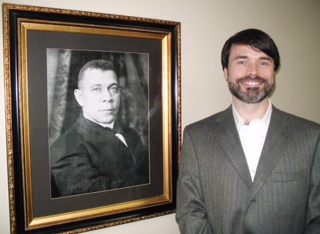
John Waldron is a history teacher at Booker T. Washington High School. His earlier contribution to the OK Policy Blog is “The public education crunch goes from bad to worse.”
On March 30 I took a group of teachers and students to Oklahoma City for the Brighter Future Education Rally sponsored by the Oklahoma PTA. It wasn’t my first rodeo. As a public school teacher, I have attended at least four rallies over the last fifteen years, including last year’s record-breaking gathering of 30,000 outside the capitol building. But this was my first attempt to go inside and talk directly to the people who write the legislation and budget for our public schools. It was an eye-opening experience.
First of all, I was impressed by the openness of the process. Together our team met with six legislators – three Republican and three Democratic. Most of the appointments were made that day, and three legislators let us walk in without an appointment. Each engaged in a frank exchange of views.
Now these are tough times for public school teachers. Budgets fell in 2009 and haven’t recovered. My class sizes are about 30 percent bigger than they were seven years ago, which was also the last time I got a raise. This legislature had already singled out the Oklahoma Education Association for a ban on automatic payroll deduction of association dues (Senator Dahm called OEA a group that “negotiates against the people of Oklahoma”). The legislators didn’t have much good news for us. Even the sympathetic ones (on both sides of the aisle) told us to expect more cuts. We pretty much expected that.
In the course of the discussions, we gained some interesting insights into how teachers and education issues are viewed at the Capitol. One argument we heard: “there is no funding crisis – cuts to education have been restored, or almost restored, over time.” Another: “teachers come in asking for more, but they never say how much is enough.” Or this one: “we would like to fully fund education, but to do so we would have to drastically cut other basic services.” That one is particularly frustrating when combined with this view: “the $611 million gap has nothing to do with earlier cuts to income and energy taxes. It is entirely caused by the drop in oil prices.”
[pullquote]Many legislators did not believe there was an education crisis, or treated us as enemy lobbyists coming in ‘with the talking points they gave you.'”[/pullquote]On teacher salaries we heard some good ones: “they are only low in the region in dollar terms.” When a new teacher explained to one representative that she had a college degree and only made $32,000, he replied “but you knew that going in, didn’t you?” As for the payroll deduction issue, one senator allowed that it should not have been virtually limited to OEA, but provided a general argument that “the state should not be in the business of managing pay deductions.” Excuse me, but how can you apply your general principle to only one organization?
It wasn’t uniformly hostile. Several legislators expressed sympathy, but pointed out that they don’t see or hear from teachers enough. One legislator seemed to apologize for the supermajority, and asked for ideas about sensible bills to improve conditions for educators. But just as many did not believe there was an education crisis, or treated us as enemy lobbyists coming in “with the talking points they gave you.” For a teacher this can be hard to understand, especially when you look at the yawning gap of 500 unfilled teaching positions in the state. But when you consider the arguments against fully funding public education (public schools are ungodly, private and charter schools are better alternatives, tax cuts are preferable to more school spending, there is money to be made in testing and privatization) you can see why teachers shouldn’t expect the red carpet treatment in Oklahoma City.
No, supporters of public education funding have to become smarter and tougher. We need to stand up every day, not just on rally day, and we need to be a bigger part of the political process, like the bankers and the oilmen. The legislator who gave us the hardest time has been elected four times without ever facing a challenger from either party and has amassed $170,000 in campaign contributions. Why are education advocates giving this man a pass, and who is giving him all this money when he doesn’t need to campaign? What it comes down to is a failure of Oklahomans to practice democracy in their own state. As a social studies teacher, I see it boiling down to a need for our side to engage in the political thicket, to ask the tough questions and to make arguments that will stick with voting Oklahomans, and that also means increasing the number of Okies who vote.
Otherwise, it’s goodbye, Mr. Chips.
The opinions stated above are not necessarily those of OK Policy, its staff, or its board. This blog is a venue to help promote the discussion of ideas from various points of view and we invite your comments and contributions. To see our guidelines for blog submissions, click here.