




 OKPOLICY.ORG

For thousands of Oklahomans, the dream of a stable home is collapsing. Fast, cheap evictions, no real tenant protections, and rising housing costs have turned a basic human need into a daily crisis. Legislators had a number of policy solutions at their fingertips this session — yet they chose virtually none of them.
Tenants continue to face an unbalanced eviction process with few protections against bad actors
Oklahoma renters can go from being a day late on rent to being removed from their home in under two weeks. They also have very little recourse to hold negligent landlords accountable. Legislators chose not to change that.
Last year, legislators passed a bill to extend the timeline by five days, but the governor vetoed it. This year, Senate Bill 1209 by Sen. Julia Kirt, D-Oklahoma City — which would simply exclude Sundays and holidays from the eviction timeline — failed in the House through a 35-53 vote. When legislators were given a second chance to vote on the bill, it failed again, 40-51. Oklahoma’s short eviction timeline makes it nearly impossible for tenants to gather back rent, make arrangements to show up in court, or even find alternate housing. A modest increase in the time between an eviction notice and a court hearing can mean the difference between stable housing and homelessness.
If a landlord neglects their property, tenants only have two options: break their lease or make repairs themselves and deduct up to one month’s rent. House Bill 2015 by Rep. Daniel Pae, R-Lawton — which would have allowed tenants to recoup attorney fees, court costs, and damages if they sue their landlord and win — did not receive a Senate committee hearing before the legislative deadline. Without the additional legal remedy proposed in HB 2015, tenants living in neglected properties that require more work than one month’s rent can cover will have to either live with the poor conditions or move. However, moving is often not an option given Oklahoma’s shortage of affordable housing.
Oklahoma lawmakers also failed to advance HB 3386 by Rep. Amanda Clinton, D-Tulsa, which, in its original form, would have required mediation in eviction cases involving children. Eviction mediation uses a neutral third-party facilitator to negotiate an agreement between the landlord and tenant, with the goal of avoiding eviction. Even a watered-down version that softened the language to simply allow tenants to request mediation if available failed to get a vote in the Senate. Mediation has been successful in other states in keeping people housed. Legislators passed over an opportunity that would have increased housing stability for families and helped landlords recover back rent.
In 2024, 48,000 Oklahomans faced eviction, according to data from the Oklahoma Policy Institute. Without action, this number will hold steady. The population bearing the brunt of inaction is often babies and toddlers, given that children under the age of five are the most threatened by eviction. Research shows that eviction leads to a host of negative outcomes for children, including poor school performance, chronic absenteeism, negative health impacts, and increased likelihood of homelessness.
Legislators doubled down on bad homelessness policy
In 2024, the legislature passed a bill banning unauthorized camping on state-owned land. Under this law, unhoused Oklahomans can face fines or even jail time for sleeping outside.
During this session, Gov. Stitt signed HB 3985, by Rep. Trey Caldwell, R-Faxon, into law. This legislation allows property owners in cities with a population of more than 130,000 people according to the most recent Census –so just property owners in Oklahoma City and Tulsa – to sue municipal and county governments for property damage or reduced property value if they failed to enforce anti-homelessness laws and ordinances. Examples include bans on sleeping outside or loitering ordinances. Instead of focusing on getting people off the streets, cities and counties will waste time and resources defending lawsuits and proving they have adequately enforced harmful policies like camping bans.
Cities like Tulsa and Oklahoma City are working to get people off the streets and into stable housing. However, instead of partnering with local leaders trying to solve the problem, the legislature continues to act as a roadblock. Legislators could have chosen to address the root cause — the lack of affordable housing — but they mostly passed on that as well.
More could and should have been done to increase the state’s affordable housing stock
The state has a shortage of more than 84,000 rental units that are affordable and available for extremely low-income households — defined as those making 30 percent of the area median income, or about $20,000 — but the legislature failed to advance several bills that would have helped close the gap.
SB 1393 by Sen. Kirt would have created an income tax credit for developers to repurpose underutilized structures like unused office buildings into affordable housing. SB 1545, also by Sen. Kirt, would have allowed faith-based organizations to build affordable housing on their property without requiring a permit, avoiding a lengthy and expensive permitting process. HB 4203 by Rep. Suzanne Schreiber, D-Tulsa, would have required updated guidelines regarding single exits for fire safety to keep housing costs down without compromising safety.
Legislators did take one positive step this session: SB 1176 by Sen. Chuck Hall, R-Perry, was signed into law, creating the Water and Wastewater Infrastructure Investment Program. This loan program will support the infrastructure necessary to develop workforce housing. Lack of infrastructure has been cited by developers and local governments as a barrier to affordable housing. The program was appropriated $35 million in the state budget.
Other states show progress is possible. Oklahoma lawmakers are choosing to sit on the sidelines
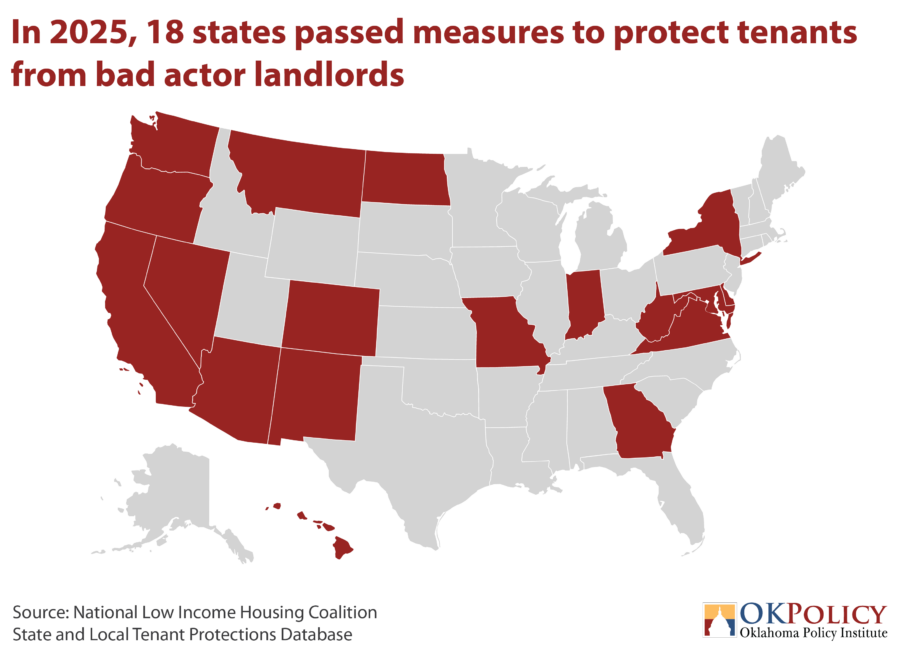
Other states are owning their role in solving the housing crisis. Some states, such as Montana and Utah, have made it easier to build more types of affordable housing, including duplexes and accessory dwelling units. Thirty-three states and Washington, D.C., have created state-based rental assistance programs to complement the federal Housing Choice Voucher program. In 2025, 18 states passed measures to protect tenants from bad actor landlords.
There is no one solution to fix housing. However, other states and communities have shown that there are a number of steps the state legislature can take to create greater housing stability for their residents. Unfortunately, Oklahoma families will continue to struggle while lawmakers sit on their hands and choose to do nothing.