



 OKPOLICY.ORG
This legislative session, property taxes have taken center stage at the Capitol. Lawmakers have filed dozens of proposals to cut, cap, or otherwise restrict property taxes, which help fund public schools and local community services.
Yet many of those proposals move forward without clear answers about how communities would make up the lost revenue. Property taxes — also called ad valorem taxes —- fund everything from public schools to fire departments, ambulance services, county law enforcement, and other essential services. Lawmakers are advancing major changes to how those services are funded without providing much, if any, information about what the impact could look like for the communities that rely on them.
• Eliminating property taxes would devastate crucial local services
• Fact Sheet: Property taxes are vital to the health of local government in Oklahoma
But communities hoping to keep the services intact once property tax revenue decreases would need to find other funding. For cities and counties in Oklahoma, the options are limited. They cannot raise income taxes, and bonds can only pay for specific projects — not ongoing services. In practice, that leaves only one other option for recurring revenue: sales taxes. And that’s where the real problem starts: sales taxes shift more of the cost onto the people who can least afford it.
Sales taxes hit low-income families the hardest
Sales taxes are one of the most regressive ways a state can raise revenue. Everyone pays the same rate at the register, whether they earn $25,000 a year or $2.5 million. But families with lower incomes spend a much larger share of what they earn on basic necessities — groceries, school supplies, clothing, and household goods.
When those purchases are taxed, a bigger portion of low- and middle-income families’ paychecks goes toward sales taxes.
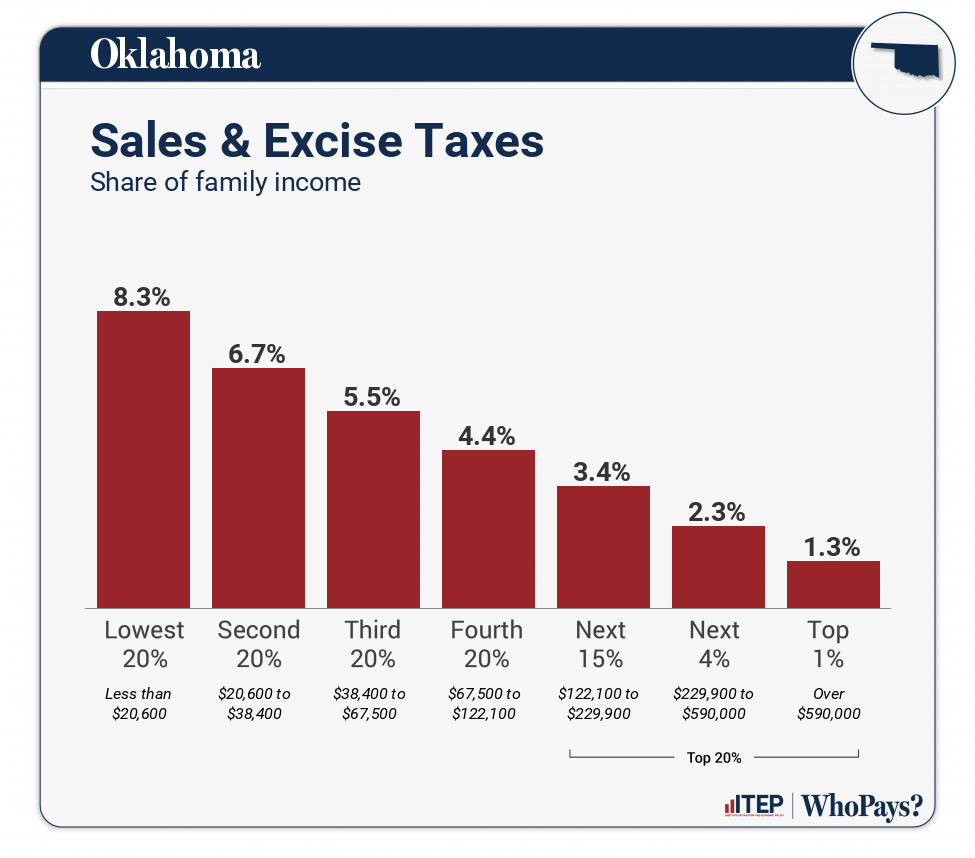
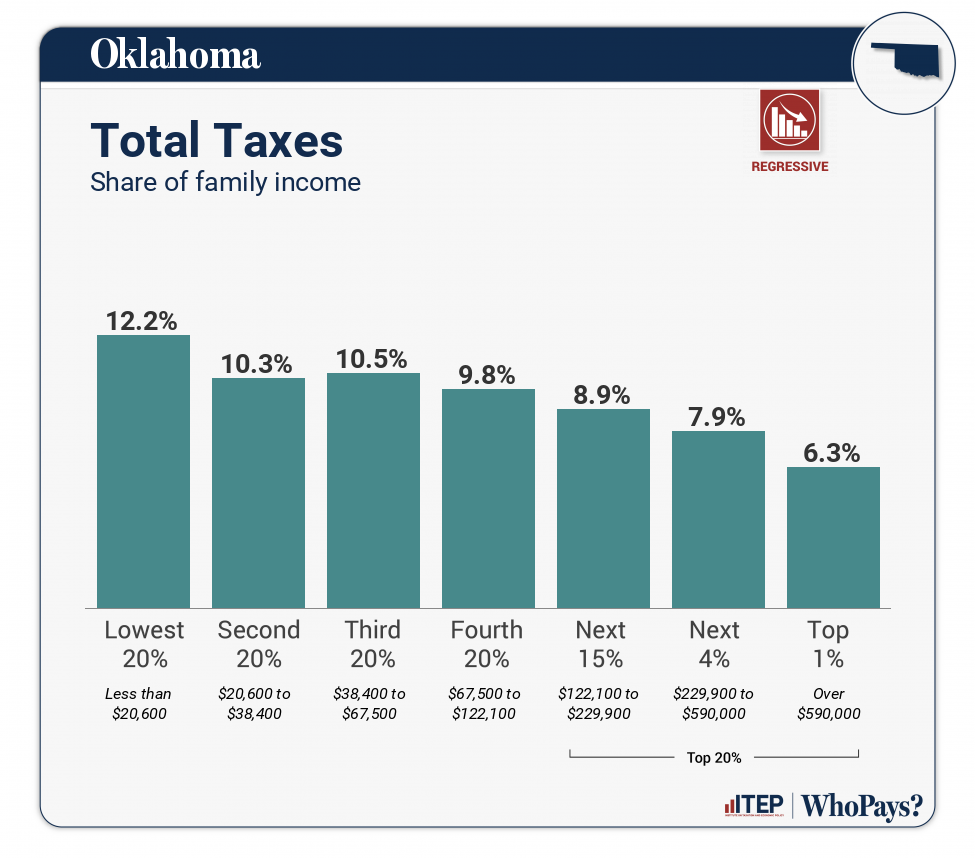
That dynamic is especially clear in Oklahoma. The lowest-income households pay about 8.3 percent of their income in sales and excise taxes, while the wealthiest households — those earning over $600,000 — pay about 1.3 percent. When you look at all state and local taxes (including income and property taxes), the gap is still clearer: the lowest-income Oklahomans pay nearly twice the share of their income in these taxes as the state’s wealthiest. The lowest earners pay about 12.2 percent of their income in state and local taxes, while the top 1 percent only pay about 6.3 percent.
In other words, families who have the least income are already paying a larger share of what they earn to support public services. Replacing property taxes with higher sales taxes would widen that gap even further, asking Oklahomans with the least to pay even more for the services we all depend on.
Property taxes aren’t perfect. They are regressive as well, but significantly less so than sales taxes. It’s fair for lawmakers to talk about how property taxes affect homeowners or how to provide targeted relief for people struggling with rising housing costs. But property taxes are tied to something that generally grows alongside wealth: property values. Sales taxes, by contrast, are tied to consumption — and for many Oklahoma families, that consumption is largely basic needs and not optional.
Replacing property taxes would mean much higher sales taxes
Shifting the responsibility for funding public services to sales taxes would require dramatic increases. If property taxes were eliminated entirely, the state sales tax rate alone would need to rise to 13.25 percent to make up lost revenue, pushing total sales tax rates in some rural areas close to 20% once local taxes are included. Because most property tax bills introduced this legislative session don’t include fiscal impact statements, the exact impact is unclear — but the state sales tax rate would certainly rise above today’s 4.5% and could climb close to 13.25% depending on how much revenue is eliminated.
And Oklahoma already relies on sales taxes more heavily than most states. Oklahoma has the 6th highest sales tax (local and state combined) in the nation, surpassing Texas and Florida. About 42.7 percent — more than $2 of every $5 — of state and local funding comes from sales and excise taxes, making Oklahoma among the states most dependent on this type of revenue.
Replacing property taxes with higher sales taxes wouldn’t just make Oklahoma’s tax system less fair. It would push communities toward some of the highest sales tax rates in the country to fund the basics.
Furthermore, supporters of a shift to sales taxes often argue that it gives the consumer a choice — the idea being that people can simply buy less and pay less in taxes. But that “choice” is not evenly distributed. Families with higher incomes can cut back on discretionary spending when times are tight. For households already scraping by, most spending goes toward essentials like groceries, clothing, and household goods. Those purchases are necessary, not optional.
That same dependence on consumer spending also makes sales taxes a highly volatile funding source. In any given month, sales tax revenue collections can vary significantly. Increasing local government reliance on sales tax will also increase inaccuracies in projections and present new challenges for school and local budgets and bonding costs.
A fair tax system shouldn’t ask the most from the people who have the least breathing room in their budgets. It should make sure the responsibility for funding our communities is shared in a way that reflects people’s ability to pay — not just how much they have to spend to get through the week.