OKPOLICY.ORG

Trevor Shanklin recently completed a summer internship at the Oklahoma Policy Institute. He is a decorated disabled veteran of the Oklahoma Army National Guard where he served as a Recruiting and Retention NCO and a Combat Medic with the 1/279 Infantry Battalion. Trevor is currently a senior at Rogers State University majoring in Political Science with a minor in Public Administration.
In June, Governor Mary Fallin, Speaker of the House Kris Steele, and President Pro Tem of the Senate Brian Bingman came together to announce the Justice Reinvestment Initiative (JRI). Commenting on the JRI, Oklahoma Department of Corrections Director Justin Jones said “The first step is for us to collect and analyze…data and fully understand our situation. Once this is done we will be able to craft policy options that apply research and best practices to make the Oklahoma public safer and the criminal justice system more effective.”
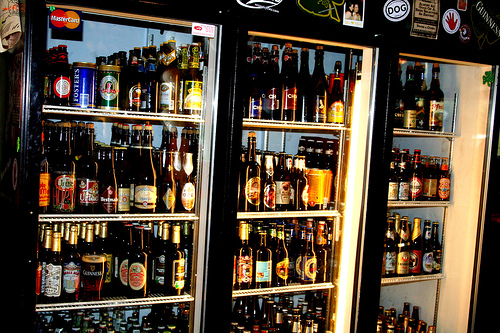
In the spirit of “collecting and analyzing data,” Oklahoma Policy Institute has prepared an an issue brief exploring one policy option which could have a substantial positive impact on the criminal justice system and public safety, along with public health and economic conditions in Oklahoma: raising the tax on alcoholic beverages. The brief, entitled Should Oklahoma Revise the Alcoholic Beverage Tax?, looks at the history and current status of Oklahoma’s alcoholic beverage tax as well as the arguments for and against an increase in the tax.
Oklahoma currently taxes high point beer at a rate of $0.40 per gallon and low point beer at $0.36 per gallon. However, the current rates were set in 1987 and have not kept pace with inflation. According to the Marin Institute, a leading alcohol industry watchdog, the beer tax has lost 47 percent of its real value over those twenty four years. Had the tax kept up with the times its current rate would be $0.76 per gallon, a $0.36 increase. This would have resulted in an additional $28.9 million in revenue for fiscal year 2009. This revenue could have helped to offset the devastating public health and safety costs associated with alcohol abuse in Oklahoma.
The Oklahoma Department of Mental Health and Substance Abuse Services (ODMHSAS) calculates that alcohol abuse costs the state nearly $2 billion every year in health care, public safety, social services, and property loss expenses. In addition, the abuse of Oklahoma’s most popular drug results in $5 billion in lost productivity in the business sector.
However, that still pales in comparison to the harm caused directly to Oklahoma citizens. According to data from the Oklahoma State Bureau of Investigation (OSBI) and ODMHSAS, 75 percent of all divorces, 65 percent of all child abuse cases, 55 percent of all domestic assaults, 35 percent of all rapes, and 33 percent of all suicides in Oklahoma stem from drug and alcohol addiction.
It is well established that raising the tax on alcoholic beverages is an effective way to decrease alcohol consumption and lower the economic, health, and social costs associated with alcohol abuse. A study in the American Journal of Public Health found that “Over the past several decades, 162 papers have been published that evaluate the effects of alcohol tax and price levels on alcohol sales, drinking, and a range of alcohol-related morbidity and mortality outcomes.” According to the study, “The major conclusion emerging from those…studies was that a 10% increase in alcohol prices resulted in an approximately 5% reduction in drinking.”
While increasing the alcoholic beverage tax is supported by a wide range of health care and public safety advocates, it would draw opposition as well. The National Beer Wholesaler Association (NBWA) argues that lower consumption resulting from increased taxation may result in fewer jobs across the state. The NBWA claims that in 2010, 16,172 thousand jobs in Oklahoma were directly related to the sale of alcohol. In addition, any tax increase requires a two-thirds vote in both houses of the legislature or approval by the people in Oklahoma as a state question.
With the new approach taken by Oklahoma’s elected leadership in “applying research” to formulate smarter public policies, considering a revision of the state’s alcoholic beverage tax provides a good starting point. Increasing the alcohol tax could provide much needed revenue for public services while reducing a long list of problems for Oklahoma.