




 OKPOLICY.ORG
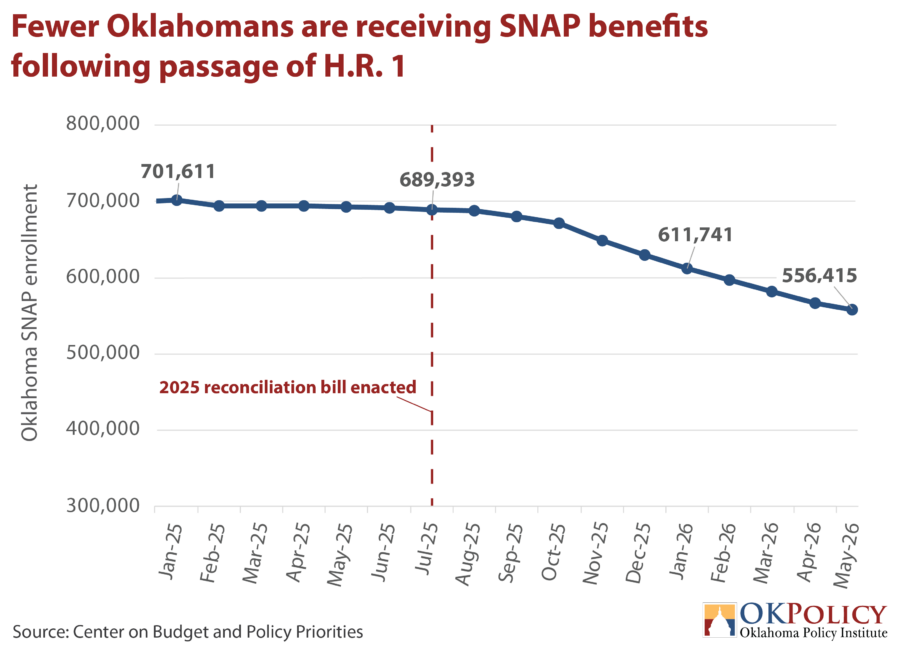
Grocery prices continue to rise, but fewer Oklahomans are receiving help buying food. Since July 2025, more than 130,000 Oklahomans have lost Supplemental Nutrition Assistance Program (SNAP) benefits — a decline of more than 19 percent.
For families losing assistance, the immediate result is a tighter grocery budget and harder choices among food, rent, utilities, and medication. But the damage won’t stop at the checkout line. SNAP cuts also drain spending from local businesses, increase demand on food banks, and undermine the health and economic stability of communities across Oklahoma.
H.R. 1 makes food assistance harder to access — and more expensive for states
House Resolution 1 (H.R. 1), also known as the One Big Beautiful Bill Act, was passed in July 2025 and paired tax cuts that disproportionately benefit wealthy households with the largest SNAP cuts in the program’s history. It expanded work reporting requirements to older adults and more parents while eliminating exemptions for veterans, people experiencing homelessness, and former foster youth. It also restricted eligibility for some lawfully present immigrants, limited future updates to the Thrifty Food Plan — the federal formula used to calculate SNAP benefit amounts — and changed how some households can deduct utility expenses.
H.R. 1 also breaks with SNAP’s longstanding funding structure. Beginning in federal fiscal year 2027, the federal government will reduce its share of SNAP administrative costs from 50 percent to 25 percent, leaving states responsible for the remaining 75 percent. Additionally, starting in 2028, states with payment error rates above 6 percent must also begin paying part of the benefits previously funded entirely by the federal government. Despite the name, these errors are not necessarily fraud. They include overpayments and underpayments caused by administrative mistakes, agency actions, or ordinary changes in household income.
Oklahoma’s most recent error rate was 11.04 percent, potentially exposing the state to millions in new costs on top of its increased responsibility for administering the program. Yet state leaders have reduced revenue through tax cuts while pressuring agencies to operate on flat budgets. That approach has left Oklahoma unprepared just as the federal government shifts more responsibility onto states.
The consequences are already visible. Average Oklahoma Department of Human Services call wait times reached three hours and 41 minutes in July — nearly nine times the roughly 25-minute wait reported one year earlier — while in-person lines have stretched longer than a football field. Families spend hours trying to prove they qualify as frontline workers confront more complicated rules and heavier documentation demands. In the rush to lower Oklahoma’s error rate, the agency is becoming less able to help the people it serves.
Work reporting requirements take away food — not barriers to employment
The new rules reach working adults, veterans, people experiencing homelessness, older adults, and families with children. For many, keeping food assistance now depends on repeatedly documenting work hours or other qualifying activities.
But most working-age SNAP participants already work, often without predictable schedules or guaranteed hours. Many more confront labor-market conditions no individual worker can control: high unemployment, too few jobs, and too few positions offering steady hours and livable wages. Meanwhile, Oklahoma’s minimum wage has remained frozen at $7.25 an hour since 2009, forcing many people to rely on food assistance even when they work full time. These are failures of wages and economic opportunity — not an unwillingness to work.
Work reporting requirements do nothing to create better jobs. Instead, research shows they take food assistance away without meaningfully increasing employment. One missed form, shortened workweek, or confusing rule can leave an eligible person with less food — but no better path to stable employment.
Every Oklahoma community will feel the loss
SNAP benefits become grocery sales, worker wages, and tax revenue. Across Oklahoma, SNAP: supported 4,484 grocery jobs and nearly 2,434 jobs in related industries; generated $179.5 million in grocery wages; and drove $432.5 million in economic activity.
When those dollars disappear, food banks face demand that they cannot fully meet. Children experiencing hunger may struggle at school, while food insecurity contributes to chronic illness and higher health care costs.
H.R. 1 does not eliminate the cost of hunger; it redistributes it. Families, state workers, businesses, schools, health systems, and charitable organizations must absorb the damage. Oklahoma leaders must protect access to SNAP, adequately fund the Oklahoma Department of Human Services, and preserve the revenue needed to respond.
Because when food assistance is cut, every Oklahoma community pays the price.