OKPOLICY.ORG

 Each year, New York Times columnist Nicholas Kristof holds a Win-A-Trip contest for college students to accompany him on a reporting trip to the developing world. Most years, his trip explores global poverty in far-flung places like Congo or Myanmar. This year, he decided to add a stop in Tulsa to see the impact of the nation’s 20-year experiment with revamping welfare.
His disheartening findings were featured in a recent Sunday’s New York Times column. “The embarrassing truth,” he writes, “is that welfare reform has resulted in a layer of destitution that echoes poverty in countries like Bangladesh.”
In 1996, President Bill Clinton and a Republican Congress approved legislation to “end welfare as we know it.” Under the replacement Temporary Assistance for Needy Families (TANF) program, it became harder for single parents to qualify for cash support. Recipients were subject to work requirements, harsh penalties for non-compliance, and strict time limits for receiving assistance.
Twenty years later, the result is that welfare barely exists in Oklahoma. A monthly average of just 2,469 adults were enrolled in TANF in Oklahoma in fiscal year 2015. That’s less than the number of women in Oklahoma prisons. Prior to the 1996 law, Oklahoma provided cash assistance to half of all families in poverty; now it goes to fewer than one in ten. The share of poor families receiving cash assistance in Oklahoma is less than half the national average (23 percent) and eighth lowest in the nation. Even during the depths of the recession in 2008-2010, while the number of children in families with no working parent rose substantially, the number of TANF recipients barely budged.
Furthermore, even for those families that do manage to qualify for cash support, the benefit is well below what is needed to get by. The maximum cash payment for a family of three in Oklahoma is $292 per month, which is less than 20 percent of the federal poverty level and less than it was 25 years ago. The average TANF family receives less than $200 each month in cash support.
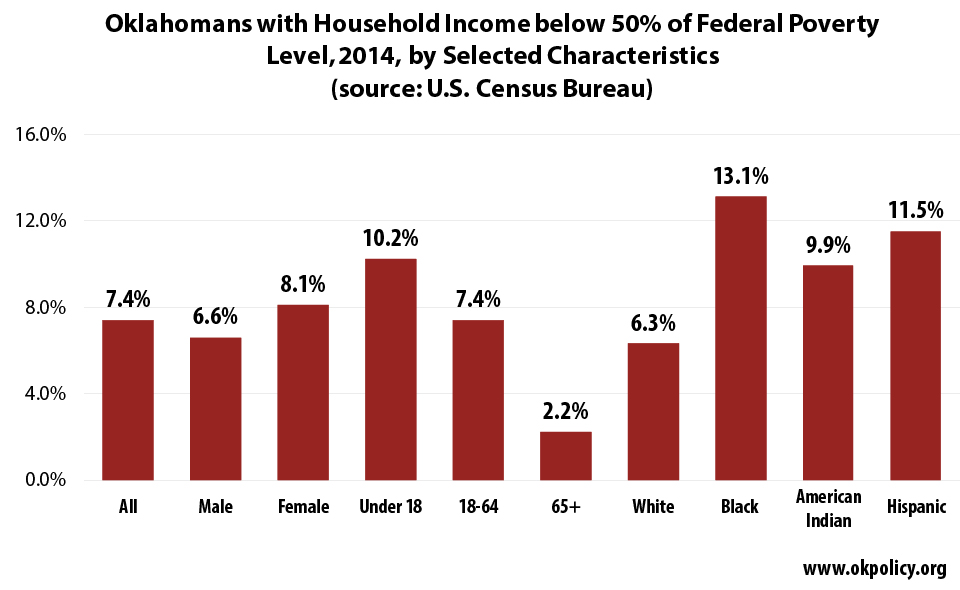
It’s the plight of children in families with incomes far below the poverty level that drew Kristof’s attention during his time in Tulsa. Extreme poverty is defined by the U.S. Census Bureau as household income of less than 50 percent of the poverty level, which is $10,450 per year for a family of three, or $200 a week. There are now about 270,000 Oklahomans living in extreme poverty, including 95,000 children, or slightly more than one out of every ten Oklahoma children. Nationally, three million children live in households earning less than $2 per person per day, according to an important new book on extreme poverty in America by Katheryn Edin and Luke Shafer.
Kristof interviewed some of the Oklahomans in extreme poverty, like Bobbie Ingraham, a 47-old recovering addict who is raising her young granddaughter. Ingraham receives SNAP support to purchase food but has zero cash income. Zero. Without income, Ingraham is unable to make utility payments in the house she inherited from her grandmother and has had her electricity, gas, and water cut off.
[pullquote]“Due to repeated budget cuts and a mix of indifference and disapproval regarding families in poverty, every one of the investments that Kristof champions has been cut in Oklahoma in recent years.”[/pullquote]
Kristof declares welfare “reform” a failure, but he is not calling for a return to the pre-TANF welfare program. Instead, he calls for greater investments in programs that have been shown to support children and families, such as parenting coaching, high-quality early childhood programs, financial literacy training, drug treatment, and job training. Unfortunately, due to repeated budget cuts and a mix of indifference and disapproval regarding families in poverty, every one of the investments that Kristof champions has been cut in Oklahoma in recent years.
Faced with a 30 percent cut in its programs and activities budget, the state Department of Education slashed funding for high-quality early childhood programs by $2.5 million and eliminated funding for financial literacy programs. Oklahoma used to invest heavily in parenting training for disadvantaged families, but the Department of Education just eliminated the last $1 million from the Parents-as-Teachers program, while the Health Department has cut funding for the Children First program by 30 percent since 2011. Until five years ago, the state provided over $2 million for adult education programs; that funding was wiped out in 2011. Drug treatment providers had their contracts cut earlier this year by the Department of Mental Health and Substance Abuse Services, and those in need of residential drug treatment face long waiting lists. The number of families qualifying for child care subsidies has been declining for years, and in June DHS announced a freeze – to be lifted in August – on accepting new families for subsidies. And as a final blow, a single mother with two kids working year-round at $10/hr will now lose $231 a year because the Legislature cut the state Earned Income Tax Credit.
This systematic undermining of the safety net is why the plight of low-income families in Oklahoma is being compared to those in Third World nations. Oklahoma lawmakers needs to grapple with the harsh reality that a large number of our state’s children are being raised in extreme poverty — and Oklahoma has nothing even close to a real strategy in place to address the problem.