



 OKPOLICY.ORG
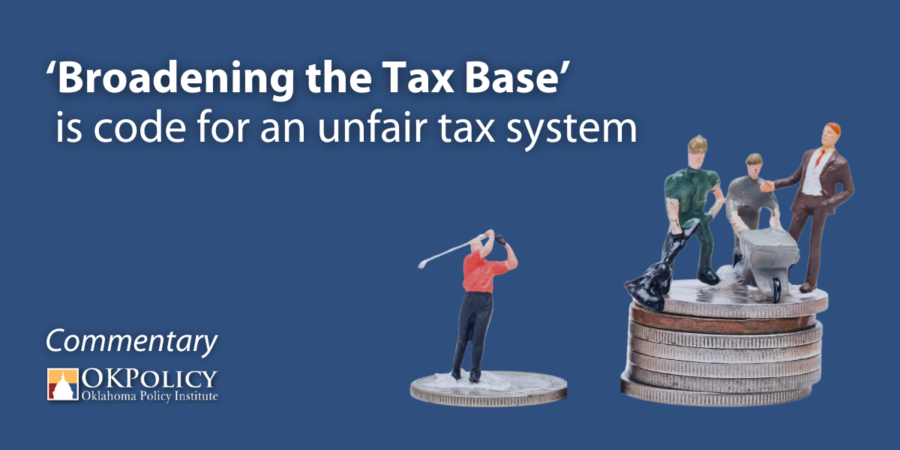
Broadening Oklahoma’s tax base sounds like common sense. Put simply, broadening the tax base means increasing the number of people to whom a tax applies, an approach viewed favorably by lawmakers from both political parties. Broadening the tax base is smart tax policy because it spreads responsibility across more people rather than a smaller segment of the population. In theory, this means fewer loopholes, exclusions, incentives, tax credits, and deductions — leading to a steadier flow of revenue to pay for roads, schools, health care, and other public needs.
But in real life, “broadening the base” is more of a slogan than an actual goal. Any tax — income, sales, property tax — can be improved by making it apply to more people. However, in states like Oklahoma that are set to eliminate their income taxes, lawmakers often use sales tax broadening to accommodate these revenue cuts. Most lawmakers overwhelmingly support cuts to income taxes first, promising to broaden the sales tax base later to make up the difference — a step that almost never happens. This leaves the state with less money, lawmakers scrambling to fill gaps, and a tax system that is less stable, more reliant on the lower- and middle-class, and less able to pay for what people need every day.
A fairer tax code goes beyond expanding the tax base
The disagreement emerges when deciding how other aspects of the tax code should change. Fair tax policy calls for broadening the base while also implementing tax structures that require higher-income households and corporations to pay a larger share of their income in taxes. These are seen as complementary policies, where both generate revenue, rather than as substitutions in which one replaces the other.
But critics disagree. Organizations like Americans for Prosperity and the Tax Foundation advocate for tax cuts that favor higher-income individuals while promoting a broader sales tax base to recapture revenue. Expanding sales taxes while cutting income taxes sets up an upside down tax structure; this approach relies heavily on low-income households and rural communities while it benefits the wealthiest Oklahomans and large corporations. This is incredibly harmful because it undermines the only fair tax most states have — a graduated income tax — while increasing reliance on sales taxes, which impact lower-income households and rural communities the most.
Separately, if broadening the base is truly intended as a substitute for tax cuts, then it would make sense to pass laws that require broadening the base before or at the same time as tax cuts are implemented. Yet this rarely, if ever, happens. Instead, the systematic elimination of income taxes continues as state revenue decreases. This forces government agencies to do more with fewer resources at a time when the federal government is pushing costs for much-needed aid programs onto states.
When states encounter challenging fiscal choices and have limited revenue-raising strategies, organizations advocating for tax cuts deflect criticism by framing their argument in a different light. They claim to not just advocate for states to cut income tax rates, but also emphasize “the need for tax reforms that ‘broaden the base’ of taxable economic activity,” and promote spending restraint . However, these claims come after the fact, as lawmakers continue slashing revenue without thinking of the consequences.
From Oklahoma to Kentucky, lawmakers have been cutting income taxes consistently, and sometimes rapidly. The past five years have seen unprecedented cuts to state income taxes in 26 states — including Oklahoma. Lawmakers supporting these cuts pointed to increased revenue and reserves in their state savings, which were largely flush with COVID-19 federal relief funds sent to states and families, and increased sales tax revenue during the pandemic. While most proponents claimed tax cuts wouldn’t impact revenue due to a supposed increase in economic activity and a broadened tax base, few states actually saw this. Instead, taxes were cut, state budgets were jeopardized, and the revenue hasn’t been replenished. In Oklahoma’s case, tax cuts and funneling tax funds to private schools cost the state close to $1.6 billion1 in revenue each year (in 2026 dollars).
Broadening the tax base is not a policy priority; it’s a farce
Oklahoma lawmakers have considered some policy ideas to expand the tax base, but nothing of substance has been done yet. During an interim study discussing the elimination of property taxes — a policy choice that would decrease the state’s tax base — lawmakers toyed with the idea of expanding the sales tax to include services like lawnmowing, haircuts, and streaming services. While expanding revenue collection sources is a good policy choice, replacing one revenue source for another less fair one isn’t wise. Not to mention, when asked if they personally would vote to implement sales taxes on services, hesitant lawmakers spoke with caution . Indeed, one lawmaker expressed concern that shifting to higher sales taxes would place greater burdens on future generations and prevent them from saving, investing in land, and accumulating wealth.
In states like Oklahoma, cutting taxes is far too easy. But raising taxes is nearly impossible because of State Question 640’s supermajority requirement: a 75 percent majority vote of both legislative chambers to increase taxes, or a simple legislative majority voting to put the issue on a statewide ballot. Even simply expanding the tax base is challenging; exemptions and incentives for industries are viewed as promoting economic growth, and removing those are politically dicey. Attempts to apply the sales tax to services would require a supermajority vote, which is unlikely to succeed. Other exemptions and tax credits targeted toward veterans, seniors, and low-income households provide vital relief to our neighbors who need them. Removing them would make Oklahoma’s tax code less fair than it already is by asking those with the least to pay more in taxes. The tax base could easily be broadened by reducing special carve outs for large corporations, but is unlikely given the strong lobbying power such companies hold.
Oklahoma faces difficult choices as revenue sources shrink
Under the Trump administration, the federal government is shifting costs onto states; as a result, the harms from cutting taxes are beginning to show. The federal government is cutting funding for SNAP and SoonerCare/Medicaid. In turn, this is forcing states to grapple with a very difficult reality: raise revenue to maintain life saving programs, or don’t and push vulnerable populations to the sidelines.
A senior Oklahoma lawmaker clearly recognizes the choice facing the Legislature. He said “as the costs of SNAP and Medicaid are shifted onto states by the new federal law , those programs could have to be eliminated” if the Legislature can’t find a way to pay for them. He adds that the Legislature’s recent decision to eventually eliminate the state’s income taxes will “put us in an even less fortunate situation because of the decline in revenue.” Even still, he ends by saying “he still hopes the tax cuts work out,” although he opposed the passage of the bill that enacted those tax cuts.
Hoping that a flawed tax cut policy can remain in place while the state faces a fiscal crisis is not enough. The Legislature recognizes that the fiscal choices they face are extremely challenging and risk the well-being of all Oklahomans. But blind faith in the incompatible belief that tax cuts can continue while SNAP and SoonerCare face funding cuts is careless, uncompassionate, and devastating for Oklahomans. It’s simple math. If lawmakers want to serve the needs of everyday Oklahomans, they need to stop further tax cuts and expand the tax base by reducing corporate incentives and carveouts. If lawmakers are serious about protecting children, families, and veterans, they should raise taxes on the wealthiest Oklahomans and large corporations to protect the most vulnerable.
# # #
1) This $1.6 billion calculation includes tax cuts from 2018 to 2026, and adjusted to 2026 values: $418 million grocery sales tax cut , $746 million in income tax cuts (Institute on Taxation and Economic Policy modeling), $181 million in corporate income tax cuts and franchise tax elimination , and $250 million for the Parental Choice Tax Credit (PCTC), also known as the Private School Voucher Program. [Click here to return to article]