OKPOLICY.ORG

 Camille Landry is a writer, activist, and advocate for social justice who lives in Oklahoma City. This is the fourth in Camille’s series, “Neglected Oklahoma”, focused on Oklahomans who find themselves in a position where the basic necessities of life are hard to come by. For previous installments, click here, here and here. The people whose stories we tell are real people and their stories are true. Names have been changed to protect privacy.
I met him standing in the median strip at a busy Oklahoma City intersection. He was holding a sign that read “Homeless vet. Please Help. God bless.” I handed him a couple of dollars and drove away. I saw him in the same area a few days later. This time I asked him if he’d share his story. He shook his head. I gave him $5.
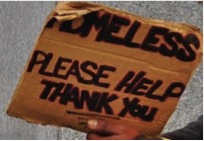 When I ran into him outside a fast food restaurant a week later, he asked me why I wanted to talk to him. I told him I was trying to understand what it was like to be homeless so that I could share that information with other people. He said he would talk to a friend but not a social worker. “For real, you’re not a social worker? You’re not a cop?” he asked for the fifth time. “I don’t need a social worker. I don’t like cops.” We sat down. He ordered 3 burgers, fries and a malt.
“You can call me Swift,” he said. “Lawrence G. Swift, Jr. I really am swift.” He laughs. “I was the fastest man on my ship when it came to loading munitions,” he bragged. “That was my job and I did it well.” He talks a mile a minute. When I comment on it he replies wryly, “My name is Swift, ya know.”
Swift is 46 years old. He is a high school graduate, a veteran of the US Navy, a husband, a father. He has three brothers and sisters and a host of other relatives. He hasn’t talked to his ex-wife, son or other family members in years. “I’m too f*cked up to be around people,” he said.
He has bipolar disorder. He hates taking the medicine that was prescribed. “It makes me shake. It makes me think slow. It makes me hungry all the time, then I throw up everything I eat.” Getting the medication is hard for him, too: Long waits at the VA clinic. Too many people. Sometimes he forgets his appointments. Sometimes he cannot force himself to walk through the door. Sometimes the voices in his head tell him that the medications are poison.
Swift also uses methamphetamine. He’s not alone – Oklahoma ranks third nationwide in meth use. Tulsa has been termed “the meth capital of the US, ” and Oklahoma City isn’t far behind. I ask how he can afford it. “I get disability,” he says. “And meth is cheap, ya know?” Thirty dollars – which he can collect by panhandling in a couple of hours – is enough to buy a meth high that lasts all day.
Swift has spent time in the VA and state hospital facilities in the past but hasn’t been hospitalized for years. There’s a waiting list at the VA for drug and psychiatric treatment. And despite Oklahoma’s high rates of methamphetamine abuse, the wait list for a bed in a rehab program can be months, even years long.
I asked Swift where he sleeps. “I used to go to the Salvation Army men’s shelter. And sometimes to the Rescue (City Rescue Mission). I just do that when it is really cold outside.” Mostly he sleeps near the I-44 bridge where he stands with his sign. “Used to be more places where you could camp out, get out of the wind and rain,” he says, “but now the police chase us away, especially downtown.” He says he doesn’t like to sleep in big rooms with lots of other people. “I’m afraid I’m gonna hurt somebody or somebody is going to hurt me.” Swift isn’t alone; the Homeless Alliance estimates that 300-400 people sleep unsheltered every night.
“I used to have a dog but he died. I miss that dog. I get lonesome sometimes.” Loneliness is just part of his troubles. Homelessness is dangerous. “People will hurt you for a couple bucks,” Swift says. You get beat up ‘cause somebody wants your boots or because you look at somebody the wrong way.”
I asked Swift how long he was going to do what he’s doing. “Until I die, I guess.” Unfortunately that event might not be far away. Homelessness dramatically elevates one’s risk of illness, injury and death. Homeless persons are three times more likely to die than the general population. The average age of death of homeless persons is about 50 years, the age at which Americans commonly died in 1900.
The leading causes of death for homeless persons are drug overdoses, HIV, homicide, heart disease. Violence (including unprovoked violence — hate crimes wherein a housed person intentionally harms a homeless person), suicide, exposure to the cold, and poor access to health care, leading to deaths from HIV/AIDS, pneumonia, cancer, alcohol withdrawal and heart disease . Methamphetamine overdoses are common in Oklahoma, which consistently ranks among the highest states in methamphetamine usage.
The Oklahoma Homeless Alliance estimates that over 300 homeless people suffer from severe mental illness, and 475 cope with substance abuse issues. Veterans are disproportionately represented. They make up approximately 12% of OKC’s homeless population.
“Do you think anybody cares?” Swift asks me as we leave the restaurant. “Do you think anybody is trying to make things better for people like me?” I tell him that some people are. “You’re as crazy as I am,” Swift replies. “I know nobody cares.”
The opinions stated above are not necessarily those of OK Policy, its staff, or its board. This blog is a venue to help promote the discussion of ideas from various points of view and we invite your comments and contributions. To see our guidelines for blog submissions, click here.