



 OKPOLICY.ORG
The U.S. House or Representatives is expected to vote tomorrow on a federal budget proposal for the coming year that would — among other things — force drastic cuts to Medicaid that would harm Oklahoma seniors, people with disabilities, and children. The budget plan, introduced by Republican Congressman Paul Ryan of Wisconsin, would also shift costs and risks onto our state and likely would force the state to cut payments to hospitals, nursing homes, physicians, and pharmacies.
Medicaid is a primary source of health insurance for seniors, persons with disabilities, and children. Medicaid is especially important for Oklahomans receiving long-term care in their homes or in nursing home facilities. It is also a cornerstone of the health care system for hospitals, physicians, pharmacies, nursing care facilities, home health care providers, and other professionals and businesses across the state. About one out of every five Oklahomans – close to 700,000 people – receive health insurance coverage through Medicaid.
The Ryan proposal would turn Medicaid into a block grant. Instead of covering a fixed share of a state’s Medicaid costs, the federal government would write a check each year. It would dramatically cut the amount of money it gives to a state, and that cut will grow bigger and bigger every year. In total, states would receive $771 billion less over the next ten years under the Ryan plan; Oklahoma would lose some $8.2 billion, according to projections from Families USA.
Some Republican Governors, including Oklahoma Governor Mary Fallin, argue that a block grant would g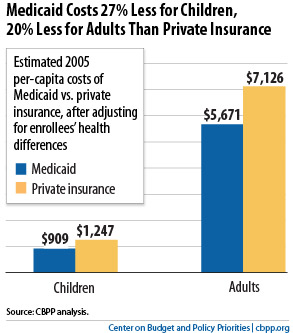 ive them greater flexibility to decide their own rules on eligibility and benefits and operate the program more efficiently. However, states already have a lot of flexibility and the capacity to save money through greater efficiency is limited. The cost of care through Medicaid has grown at a much slower pace than in private insurance and it costs less per person than private insurance. According to analysis by the Center on Budget and Policy Priorities, Medicaid costs 27 percent less for children and 20 percent less for adults than private insurance for people with similar health status, while providing more comprehensive benefits and lower out-of-pocket costs.
In reality, the Ryan budget would cut federal Medicaid spending so deeply that states would find deep cuts unavoidable, leaving seniors, children and people with disabilities without the health care they need. As the Congressional Budget Office stated in an analysis of Ryan’s budget:
Because of the magnitude of the reduction in federal Medicaid spending under the proposal, however, states would face significant challenges in achieving sufficient cost savings through efficiencies to mitigate the loss of federal funding. To maintain current service levels in the Medicaid program, states would probably need to consider additional changes, such as reducing their spending on other programs or raising additional revenues. Alternatively, states could reduce the size of their Medicaid programs by cutting payment rates for doctors, hospitals or nursing homes; reducing the scope of benefits covered; or limiting eligibility.
In Oklahoma, with no end in sight to the state budget crisis, reduced federal Medicaid funding would mean cutting provider rates, benefits or eligibility. Cutting provider rates would threaten the livelihood of many health care providers, and would likely lead many to withdraw from the program, endangering access to timely and appropriate care. Reducing benefits would risk depriving people in the poorest health – persons with disabilities and chronic health conditions – of needed services. Limiting eligibility is likely to especially affect children, undoing the progress Oklahoma has made in covering more kids, and persons with long-term care needs who are currently being served in home and community-based waiver programs. All these cuts would have their greatest impact in poor and rural parts of Oklahoma, where Medicaid participation rates are highest and provider networks are most limited.
While there is a definite need for reasonable steps to address rising health care costs and tackle the federal deficit, this is the wrong approach. Capping federal spending through a block grant would be bad for the state budget, bad for Oklahoma’s health care providers, and bad for the low-income seniors, persons with disabilities, children and families who count on Medicaid for the health care they need.