



 OKPOLICY.ORG
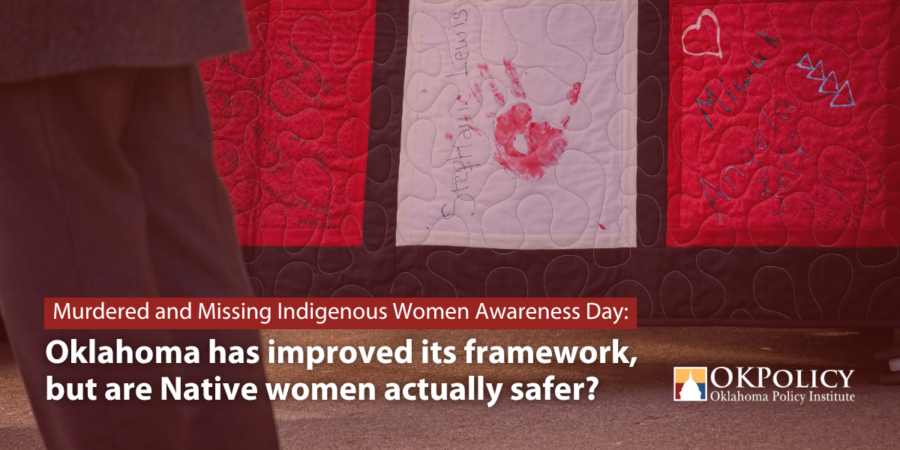
Content note: This article discusses violence against Indigenous women, including domestic violence, sexual assault, and homicide. No details of this violence are included. While the Oklahoma Policy Institute exists to share facts and information, we acknowledge that these are the lived realities for many Native families and communities, including my own. This data is hard to come to terms with. Please put your mental health and well-being first.
If this topic feels heavy or personal, you are not alone. Please reach out. Support is available:
- StrongHearts Native Helpline: 1-844-7NATIVE (1-844-762-8483)
- National Domestic Violence Hotline: 1-800-799-7233
- RAINN: 800-656-HOPE
- 988 Suicide & Crisis Lifeline: Call or text 988
These services are free, confidential, and available at any time.
– – –
On May 5, Missing and Murdered Indigenous Women Awareness Day, Oklahoma should reflect honestly on both the progress made and the work still left undone.
This article focuses on progress addressing Missing and Murdered Indigenous Women. I use “women” in the most inclusive way, but most available data does not include non-binary, Two-Spirit, or other gender-diverse people. Indigenous people of all genders matter deeply, both within their communities and in conversations about violence. It is already difficult to find accurate data on Indigenous women, and it becomes even more limited for those with marginalized gender identities. Indigenous men are also part of this story and should not be overlooked. Many organizations now use the term Missing and Murdered Indigenous Persons to reflect this wider reality. If a Tribe or group uses the term MMIP in their official name, the article will use that term. Everywhere else, I will use MMIW to center Indigenous women here to honor the leadership of Native women advocates who brought this issue forward.
Over the last five years, Oklahoma has taken more steps to address the Missing and Murdered Indigenous Women (MMIW) crisis than it had in decades before. Tribal Nations, Indigenous women, and Native advocates pushed this issue into public view. They refused to be ignored, prompting greater awareness and systems to address violence against Native women. The question now is not whether the topic is getting more attention. The question is whether that attention has yet made Indigenous women meaningfully safer. Data limitations leave us without a clear answer, making it difficult to know whether recent policy changes are actually improving safety or where further action is needed.
Native women and Tribal Nations have consistently led these structural and political changes
Since 2020, the Cherokee Nation has expanded its ONE FIRE Victim Services office, added marshals and prosecutors, and hired a full-time investigator to work exclusively on MMIW cases. Chickasaw Nation’s Violence Prevention Services provides domestic violence, sexual assault, stalking, shelter, safety planning, and transportation. At the same time, the Choctaw Nation has expanded wraparound services through the Ahni Center for survivors of domestic violence and sexual assault. The Comanche Nation has also instated an MMIP program that uses restorative justice and Comanche culture and knowledge to educate, prevent, and respond. Additionally, the Citizen Potawatomi Nation operates the House of Hope, which provides programs and services, including a domestic violence shelter, educational programming, and community advocacy events. These are just a few highlights of the 39 Tribes in Oklahoma, many of which provide services to both Native and non-Native victims of violence.
Native advocates also deserve to be named. Cheyenne and Arapaho citizen LaRenda Morgan was a leading advocate for Ida’s Law — named after her cousin Ida Beard, who went missing in 2015 — and helped draft the original measure. Carmen Harvie, a Choctaw and Hualapai advocate who lost her niece in a tragic double homicide, has helped lead the Oklahoma MMIP movement as their current State President. Today, there are more than 20 MMIP advocacy chapters across the state. The Native Alliance Against Violence, a Tribal domestic violence and sexual assault coalition non-profit founded in 2009, has spent years supporting Tribal programs and pushing the state toward a better response. These grassroots coalitions and their leaders are the reason we have made so much progress on MMIW issues. They put years of hard work into MMIW advocacy that has led to the current awareness of this crisis in Oklahoma and across the Nation.
The biggest state-level shift came in 2021, when Oklahoma enacted Ida’s Law. The law directed the Oklahoma State Bureau of Investigation (OSBI) to create an Office of Liaison for Missing and Murdered Indigenous Persons to improve coordination among Tribal, state, and federal agencies. This was an important structural change, as jurisdictional confusion has long been one reason these cases often fall through the cracks.
Even though OSBI did not secure the outside funding originally proposed within the law, the agency still assigned two agents from the Cold Case Unit to lead the MMIW case efforts. By 2023, OSBI estimated there were at least 500 missing or murdered Indigenous people cases in Oklahoma from data of unresolved and resolved homicides and missing persons cases in the National Crime Information Center (NCIC) compiled after Ida’s Law passed.
OSBI is also working to improve public access to information about missing persons. According to the agency’s MMIP unit, a new public-facing missing persons database is set to launch in early May. The database will pull cases directly from the National Crime Information Center (NCIC), with a short delay between when a case is entered and when it becomes publicly visible. It will include basic case details, photos, and the ability for the public to generate shareable flyers. This type of tool has the potential to increase visibility and community engagement in active cases, which can be critical in the early stages of a disappearance. These tools can strengthen responses and increase visibility, but they also depend on the accuracy and consistency of the underlying data. Without that, it remains difficult to determine how effective these efforts will be in practice.
In 2025, Oklahoma lawmakers passed House Bill 1137, removing language that tied the MMIW liaison office solely to outside funding and making it easier for the office to continue its work. While Gov. Kevin Stitt initially vetoed the bill, the legislature overwhelmingly overrode that veto — 91-0 in the House and 40-4 in the Senate. This level of legislative support was a concrete sign that support for MMIW work had become more durable and widespread than it was five years earlier.
There has also been a broader buildout of state response tools related to intimate partner violence, a key place where intervention can prevent escalation. Oklahoma’s lethality assessment protocol, which became law in 2021 under Senate Bill 17, requires officers responding to intimate partner violence calls to screen for homicide risk and connect high-risk victims to victim service providers, including Tribal programs. By April 2026, the Attorney General’s office said nearly 1,000 Oklahoma officers had been trained to use the tool. While this law benefits all Oklahomans who are victims of domestic violence, not just Native women, it is part of the prevention infrastructure that can matter before a woman becomes a missing person or victim of homicide.
Violence against Native women remains a crisis in Oklahoma and across the nation
In 2016, the National Institute of Justice research found that 84.3 percent of American Indian and Alaska Native women have experienced violence in their lifetime, 56.1 percent have experienced sexual violence, and 39.8 percent experienced violence in just the past year. Native women were also 1.7 times as likely as non-Hispanic, white women to experience violence in the past year. In a similar study, the national average of women who reported that they have experienced violence in their lifetime is between 42 percent (physical violence) and 49 percent (psychological violence).
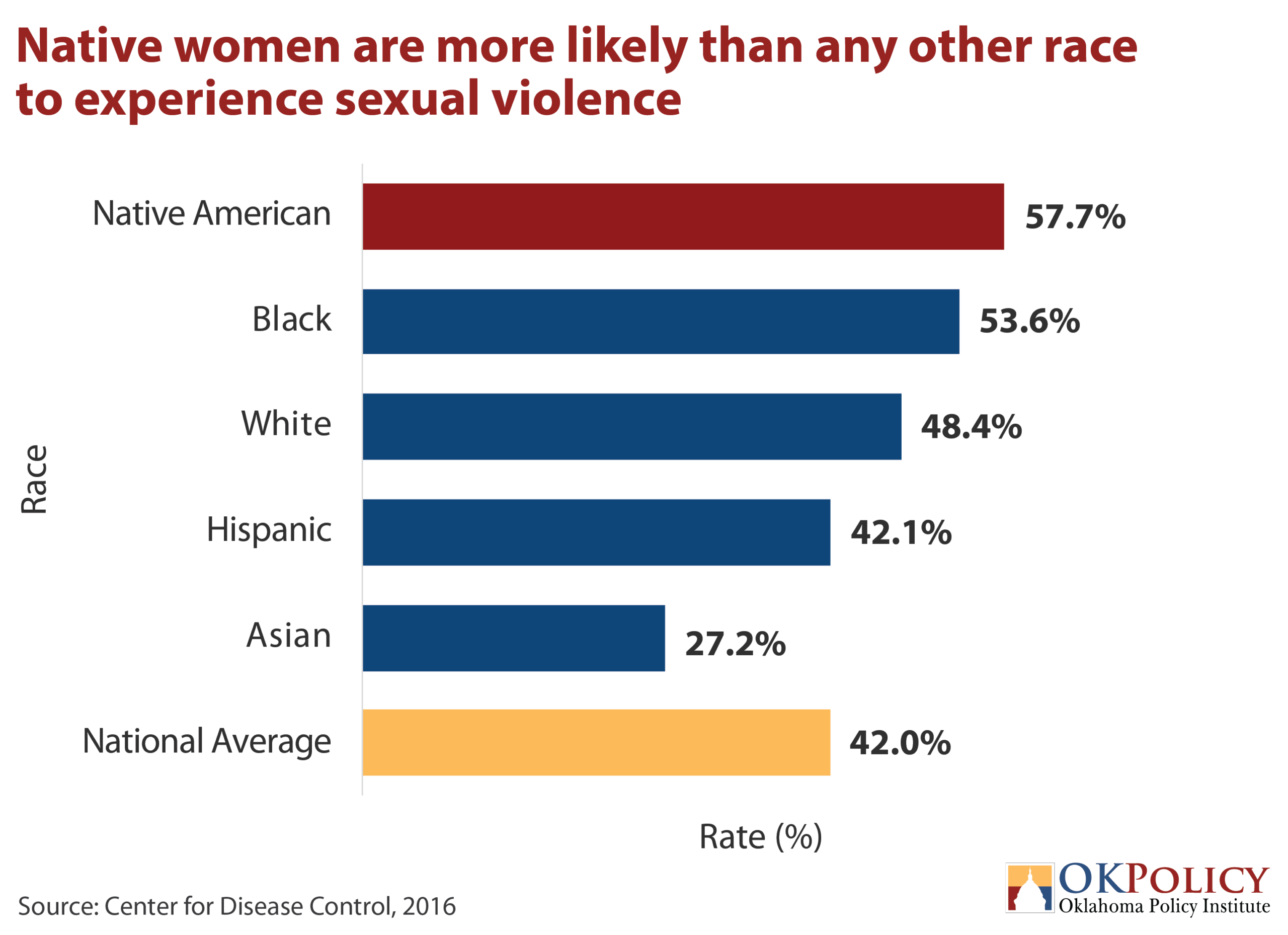
This crisis is especially important to understand in Oklahoma because of the large Native population in our state. The U.S. Census Bureau reports that Native people make up about 9.6 percent of the state’s population, compared with about 1.4 percent nationally. In the Urban Indian Health Institute’s 2018 report, Oklahoma had the 10th-highest number of MMIW cases. Oklahoma City also ranked 10th among cities with the highest number of MMIW cases not recorded by law enforcement, meaning that in 2018, due to misclassification by law enforcement, the Oklahoma City metro was not counting or identifying all MMIW cases.
But the numbers do not yet show safer outcomes for Indigenous women
One of the most frustrating realities of the MMIW crisis is that even as Oklahoma builds a stronger response, we still cannot clearly measure whether Indigenous women are safer over time due to major data gaps. Some statistics show that Native Americans are overrepresented – meaning the group makes up a higher percentage of the victims than their percentage of the population – or underrepresented – meaning they make up a smaller percentage of the victims relative to their population – in the data, making it difficult to assess whether recent policy changes are working or where to focus resources. At the national level, there is still no reliable national count of how many Native women go missing or are murdered each year. A 2021 U.S. Government Accountability Office (GAO) report found that federal agencies cannot produce a complete or consistent dataset, as multiple systems track cases but fail to communicate with one another. Underreporting, misclassification, and fragmented jurisdiction continue to make it difficult to know whether year-to-year changes reflect less violence, better recordkeeping, or both. The lack of updated national studies has led to a patchwork of information that is difficult to navigate and interpret, which makes it challenging to determine whether or not legislative interventions and improved awareness of MMIW cases are actually having an impact on the outcomes and experiences of violence in Native communities.
When data does exist, it is often incomplete or incorrect. Indigenous victims are frequently misclassified in law enforcement records, including being recorded as white, Hispanic, or “other.” Cases are underreported, databases do not communicate across jurisdictions, and some cases never enter official systems. According to National Crime Information Center data from 2016, 5,712 Indigenous women and girls were reported missing, but only 116 cases were recorded in a federal database.
According to the Oklahoma Domestic Violence Fatality Review Board report in 2024, there were 87 victims of domestic homicide in Oklahoma during 2024, a 29 percent drop from the previous year and the lowest number since 2017. That 2024 drop is encouraging, but Native Oklahomans were still 30 percent more likely to be victims of domestic homicide. In 2025, 12.6 percent of homicide victims from domestic incidents and 8 percent of domestic abuse victims were Native American. Both numbers, however, were down from the previous year.
Native Americans are more likely to be victims of domestic homicide
| Group | Victim Share | Population Share | Relative Rate | What This Means |
| Women | 39.10% | 50.20% | 0.78× | Women are underrepresented among victims of domestic homicide |
| White | 72.40% | 72.60% | 1.00× | Proportional to the population for domestic homicide victims |
| Black | 12.60% | 7.90% | 1.59× | About 60% more likely to be domestic homicide victims |
| Native American | 12.60% | 9.60% | 1.31× | About 30% more likely to be domestic homicide victims |
| Asian | 2.30% | 2.80% | 0.82× | Slightly underrepresented amongst victims of domestic homicide |
| Hispanic | 13.80% | 13.50% | 1.02× | Roughly proportional to the population for domestic homicide victims |
| Source: This analysis compares victim demographics from the Oklahoma Domestic Violence Fatality Review Board’s 2025 report with statewide population data from the U.S. Census Bureau, using a relative rate calculation to assess whether groups are over- or underrepresented among victims. |
||||
These numbers, however, do not capture all of the violence directed towards Native women in Oklahoma. The OSBI runs a comprehensive database that tracks crimes against persons, which is a more expansive list of incidents. From 2021 to 2026, Native Americans represented approximately 7 percent of tracked victims, indicating they remain underrepresented in crimes against persons. However, it is important to note that this data relies on two fundamental assumptions: 1) Native identity is being accurately reported, and 2) individual agencies are reporting promptly to the OSBI or NamUs, a national centralized repository and resource center for missing, unidentified, and unclaimed person cases across the United States. OSBI has indicated that it is actively working to identify and correct misinformation about individuals’ Native status in its data, supporting findings from both the Government Accountability Office and the Urban Indian Health Institute from almost 10 years ago, that the current data is likely underreporting the Native status of victims of crimes. This discrepancy in data likely reflects why Native Americans are underrepresented in the data of crimes against persons from the OSBI and overrepresented in the data of domestic abuse and homicide from the Fatality Review Board.
OSBI data shows Native Americans underrepresented in crimes against persons
| Year | Total Victims | Native American Victims | Percentage | Population % | Relative Rate | What This Means |
| 2021 | 62,463 | 4,519 | 7.23% | 9.60% | 0.75× | Slightly underrepresented |
| 2022 | 65,116 | 4,767 | 7.32% | 9.60% | 0.76× | Slightly underrepresented |
| 2023 | 67,993 | 5,002 | 7.36% | 9.60% | 0.77× | Slightly underrepresented |
| 2024 | 70,903 | 4,928 | 6.95% | 9.60% | 0.72× | Slightly underrepresented |
| 2025 | 70,678 | 4,833 | 6.84% | 9.60% | 0.71× | Slightly underrepresented |
| 2026 (as of April 28) |
16,729 | 1,141 | 6.82% | 9.60% | 0.71× | Slightly underrepresented |
| Source: OSBI’s Statistical Analysis Unit for Total Victims & Native American Victims. The population percentage for Native Americans is from the Census Bureau. This analysis uses a relative rate calculation to assess whether groups are over- or underrepresented among victims. |
||||||
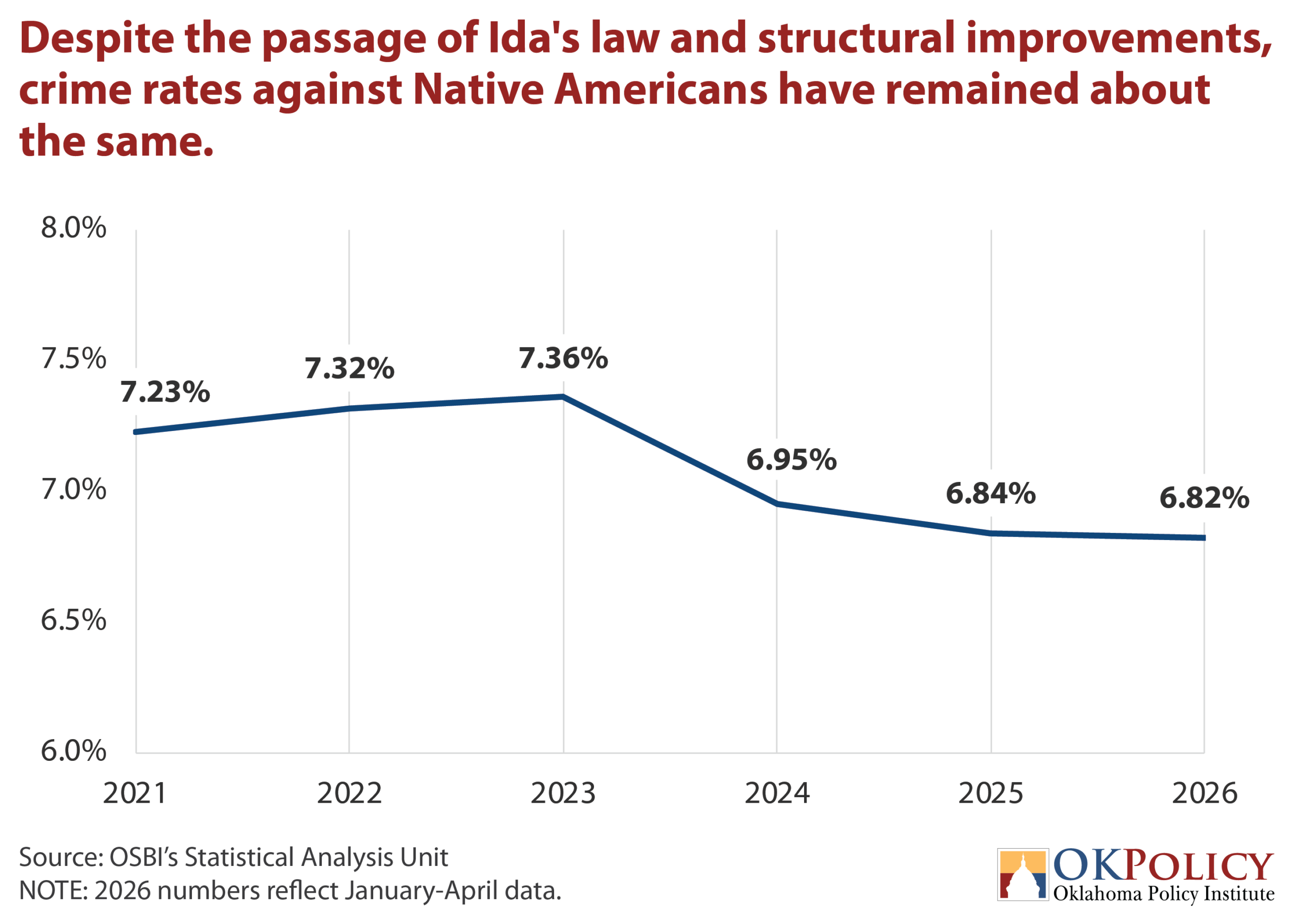
Updated studies are needed to assess whether the accuracy of reporting and communication between law enforcement agencies has improved since the GAO and Urban Indian Health Institutes reports were produced. Optimistically, we can hope that changes to protocol and the awareness raised by MMIW advocacy have improved data collection and that the rate of violence against Native people has declined. However, without corroborating studies to support those findings, the data is not there to substantiate claims that the changes implemented since Ida’s law on MMIW reporting or prevention have led to either more accurate data or less violence against Native people. If systems do not accurately identify Indigenous victims, then the scope of the crisis cannot be fully understood, making it harder to design and evaluate effective responses.
So, is it actually safer for Indigenous women?
It is fair to say Oklahoma is better positioned to respond than it was five years ago. There is more public awareness, more Tribal infrastructure, a formal state MMIW liaison structure, more trained personnel, and stronger public recognition of the crisis. Those changes matter. They will save lives. But improved response is not the same as proven safety.
Right now, Oklahoma cannot clearly show that violence against Native women is declining. The data is too incomplete and inconsistent to establish long-term trends. In some cases, increases in identified victims may reflect better reporting rather than higher levels of violence. Yet without reliable studies and consistent data collection, it remains difficult to measure whether recent policy changes are producing meaningful improvements or to determine which approaches have been most effective. This creates not just a research gap, but also a policy gap. When policymakers cannot measure what works, they cannot effectively evaluate programs, allocate resources, or ensure accountability.
To truly address this issue, Oklahoma needs sustained investment, better data, and better relations with our Tribal Nations and Tribal citizens. That includes stable funding for OSBI’s MMIW office and improved public reporting to help Oklahomans track outcomes and lawmakers make informed decisions. It also means investing in comprehensive, up-to-date studies on violence against Native women, including research that is developed in partnership with Tribal Nations and reflects the realities of diverse Indigenous communities.
For Tribes and Tribal leaders, this means continuing to support and strengthen Tribal victim service programs, Tribal law enforcement, and Tribal courts. For the state and federal government, it means not only supporting those efforts, but also listening to Native women at the grassroots level and responding to their concerns and critiques.
Oklahoma has built stronger infrastructure, but the next step is to prove that those responses are working.
– – –
Seeking Justice for Our Missing and Murdered
Behind every number in this article is a woman, a girl, a person, a family, and a community still searching for answers. For many Native families in Oklahoma, this crisis has hit close to home.
There are still many Indigenous women and girls missing across this state, and many unsolved murder cases. Oklahoma has 39 missing Indigenous women currently entered into NamUS. These missing women range from 13-year-old Rhonda Anderson to 52-year-old Jolene Beard Wauahdooah.
Their families are still waiting for answers.
You can learn more about these cases or help bring attention to them here:
- National Missing and Unidentified Persons System (NamUs)
- Oklahoma State Bureau of Investigations Cold Case Files
If you have any information, no matter how small it may seem, you can contact:
- Oklahoma State Bureau of Investigation Tip Line: 1-800-522-8017 or tips@osbi.ok.gov
- Oklahoma Crime Stoppers: 1-800-632-8477
- Federal Bureau of Investigation – Oklahoma: 405-290-7770
- Bureau of Indian Affairs Missing and Murdered Unit Tip Line: 1-833-560-2065 or OJS_MMU@bia.gov
Even the smallest detail could help bring someone home or give a family answers.
If reading or engaging with these cases becomes overwhelming, or if you realize you need help, please reach out. You are not alone.
- 988 Suicide & Crisis Lifeline: Call or text 988
- StrongHearts Native Helpline: 1-844-7NATIVE (1-844-762-8483)
- National Domestic Violence Hotline: 1-800-799-7233 or thehotline.org
- RAINN: 800-656-HOPE or rainn.org