OKPOLICY.ORG


 There are honest arguments and discussions to be had about the place and role of government. However, we generally agree that the government has an important role in protecting the lives and health of Americans who aren’t able to protect themselves, including those who are elderly or have significant disabilities.
However, in Oklahoma, years of budget cuts have now compromised our Department of Human Services’ ability to fulfill this core function of government. As a result, thousands of Oklahomans who are elderly or have disabilities could lose access to vital services in just a few months. Without a supplemental appropriation, DHS doesn’t have the funds to pay providers for the care of more than 25,000 Oklahomans after April.
Years of cuts have compromised DHS’s ability to fulfill its basic responsibilities
This situation is the result of years of inadequate funding combined with a diversion of resources to make court-ordered child welfare reforms. These reforms, known as the Pinnacle Plan, have consumed what funding increases DHS has seen and then some. Divisions other than child welfare are down to two-thirds the workforce they had in 2011.
With DHS running out of administrative expenses to trim, cuts are now directly affecting clients and client services: lower staffing levels mean less oversight of child care facilities, less investigation of allegations of abuse and neglect of vulnerable adults, closed meal sites for food-insecure seniors, a temporary freeze on child care subsidy enrollment, and possibly longer processing times for SNAP and heating/cooling assistance. All told, a full third of the FY 2017 budget cuts came out of client services, including waiver programs providing care to Oklahomans who are elderly or have disabilities. In total, DHS has cut its budget by some $200 million the past two years.
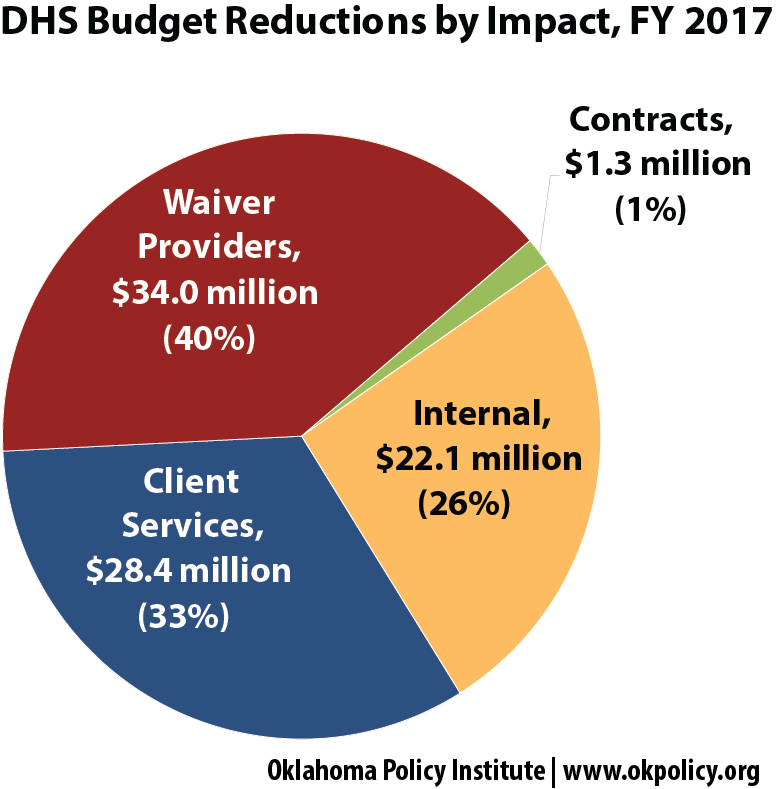
Without a supplemental appropriation, DHS can’t pay waiver providers after April of this year.
Waiver programs, so called because they waive some federal Medicaid requirements, are an opportunity for states to develop programs specific to their needs. Five specific waivers operated by the state Department of Human Services are under threat now.
The Medicaid ADvantage waiver helps more than 21,000 Oklahomans in need of nursing home-level care to receive that care less expensively in their homes and communities. Four other waiver programs cover in-home and community-based care for Oklahomans with significant disabilities, including physical and occupational therapy, and assistance with bathing and dressing. More than 5,000 Oklahomans receive needed services through these waivers, with more than 7,400 people waiting more than a decade to join them.
In order to continue to pay providers for these programs after April, DHS needs a midyear supplemental appropriation. The agency is requesting $42.6 million in supplemental funds, of which $34 million would go to paying waiver providers for the last two months of the state fiscal year, while the remainder would address an adoption subsidy payments shortfall ($4.8 million) and the Pinnacle Plan ($3.8 million).
What will happen on May 1 if the supplemental doesn’t happen or is underfunded is unclear. In order to qualify for these waiver programs to begin with, recipients have to be low-income, so it is highly unlikely that they could pay for these services out of pocket. Some elderly Oklahomans may be forced to move to nursing homes, which will only multiply the cost to the state. Providers, many of which are small, locally-owned businesses operating on very fine margins, may shut down. Between the aging and disabilities waiver programs, DHS contracts with more than 2,500 providers. Should the waivers fail, more than 25,000 Oklahomans who are elderly or have disabilities – as well as their families, friends, caregivers, and communities – will bear the brunt of the state’s failure to fund core functions of government.
The bottom line
Most disputes at the Legislature, whether it’s a teacher pay raise or a cigarette tax increase, are fundamentally about the budget. However, even with its other assorted budget challenges, the Legislature has the responsibility to find a solution that ensures the most vulnerable members of our community can access the care they need. If lawmakers don’t act soon, Oklahoma could leave our elders and those most in need of our protection in serious peril.