



 OKPOLICY.ORG

Nearly half (49 percent) of Oklahoma’s households are locked into a “new normal” of perpetual financial insecurity, unable to build the savings needed to last even three months in the event of an emergency, according to a new report from the Corporation for Enterprise Development (CFED). The research, reflected in CFED’s 2016 Assets & Opportunity Scorecard, also found that state policies can do much more to improve the financial security of Oklahomans.
Published annually, the Assets & Opportunity Scorecard offers the most comprehensive look available at Americans’ ability to save and build wealth, stay out of poverty and create a more prosperous future. This year’s Scorecard assesses all 50 states and the District of Columbia on 61 outcome measures spanning five issue areas: Financial Assets & Income, Businesses & Jobs, Housing & Homeownership, Health Care and Education. It also ranks the states on 69 policies that promote financial security.
Oklahoma’s 34th‐place outcome ranking dropped three positions from last year’s 31st‐place ranking. The relative bright spots were in the areas of Businesses & Jobs and Housing & Homeownership, where the state received “B” grades. Oklahoma received “D” grades in both Health Care and Education, driven by one of the highest uninsured rates in the country (17.8%) and the high percentage of youth who are neither enrolled in school nor employed (15.4%). The state also received a “D” in the area of Financial Assets & Income, a reflection of the state’s high level of income poverty (15.9%) and low rates of access to prime credit or revolving credit (ranked 44th and 48th in the nation, respectively).
The Scorecard also evaluates 69 different policy measures to determine how well states are addressing the challenges facing their residents. On almost every policy measure, Oklahoma rates near the middle, including Businesses & Jobs (27th), Housing & Homeownership (33rd), Health Care (20th) and Financial Assets & Income (20th). The state fared best on Education, where it ranked 6th, having implemented nine of 18 policies that can help Oklahomans get the education they need to access greater opportunities. Programs that helped our strong education ranking include the state’s celebrated early childhood education program and the Oklahoma’s Promise college scholarships for students from low- and moderate-income families. Overall, Oklahoma has enacted only 26 of the 69 policies evaluated by the Scorecard, illustrating the opportunities the state can embrace to boost the financial security of its residents.
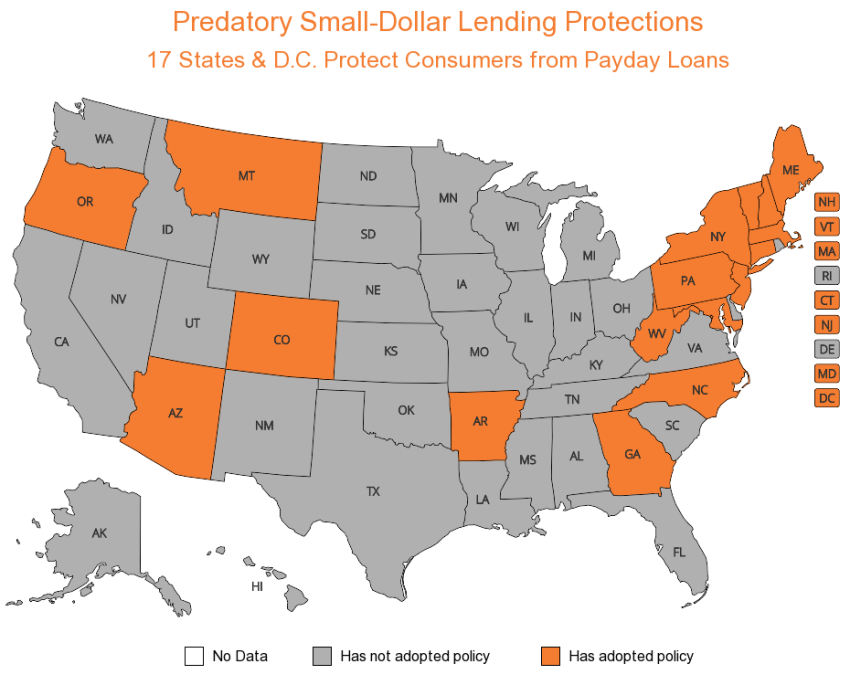
One area where we especially fall behind is in having no protections for consumers against predatory payday lending. In Oklahoma, a borrower taking out the maximum allowable loan of $500 can be charged $65 for a loan of as short as 12 days. That equates to an Annual Percentage Rate (APR) of 395 percent. These high interest loans keep borrowers in a cycle of debt when loans advertised as short term are rolled over for months. The cost grows even more when cash-strapped borrowers can’t pay back their loans or interest. In 2014, payday lenders in Oklahoma collected nearly $23 million in bounced check fees on top of $53 million in finance charges.
Policymakers have a chance to end the cycle of debt for consumers. One solution that has worked to curb predatory lending in other cities and states is to cap the APR at 36 percent or less, which would add Oklahoma to a list of 17 states plus Washington DC that have strong limits or an outright ban on payday lending. Senator Kevin Matthews has filed SB 1074 this year to limit Oklahoma’s allowed APR to 36 percent.
“There certainly are positive signs that the nation’s economy is improving,” noted Andrea Levere, President of CFED. “But there also is very compelling evidence that many households are stuck in a financial hole and are struggling to dig themselves out. State governments can play a critical role in helping them move on to firmer ground and a more prosperous future.”