




 OKPOLICY.ORG
 Damario Solomon-Simmons is OK Policy’s legislative liaison and an attorney with the Riggs Abney law firm.
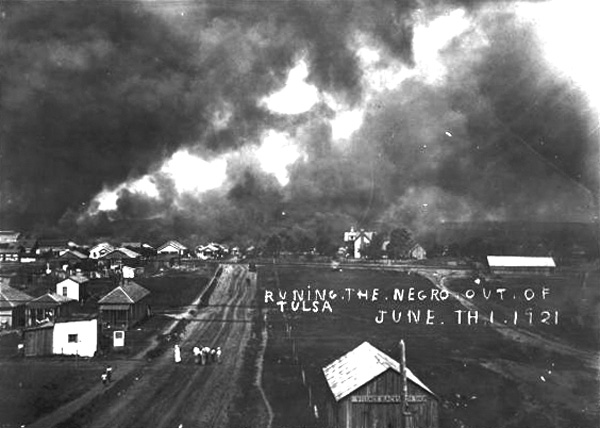
As shocking as it must have been for you to see the title of this article, imagine the shock and horror my vibrant, peaceful, and prosperous community experienced 95 years ago today when a mob of over 2,000 Whites, under the protection of city and state law and direction of city and state officials, pillaged and destroyed the Black district of Tulsa, aka Greenwood, “Little Africa,” and “Black Wall Street.”
This photo was taken as innocent Black Tulsans experienced the worst domestic terrorist attack in U.S. history. The mob literally tried to “run the Negros out of Tulsa” as they destroyed 36 square blocks, killed upwards of 1,000 people, and left 10,000 Blacks homeless, destitute, and forever traumatized.
The great Dr. W.E.B. Dubois (the first Black Harvard Ph.D., father of modern sociology, and co-founder of the NAACP) stated, “I have never seen a colored community so highly organized as that of Tulsa. The colored people of Tulsa have accumulated property, have established stores and business organizations, and have made money in oil.” In fact, Greenwood was so economically self-sufficient that purportedly a dollar circulated within the community fifty times, sometimes taking a year for currency to leave the community. Noted Greenwood historian Scott Ellsworth described Greenwood’s business district and neighborhoods before the massacre as follows:
The black population had grown to almost 11,000 and the community counted two black schools, Paul Laurence Dunbar and Booker T. Washington, one black hospital, and two black newspapers, The Tulsa Star and the Oklahoma Sun. [Greenwood] at the time had some thirteen churches and three fraternal lodges-Masonic, Knights of Pythias, and I.O.O.F.-plus two black [movie] theaters and a black public library… Along Detroit Avenue and certain other streets were the neat, sturdy homes of some of those Black Tulsans who owned businesses lining Greenwood Avenue, augmented by the houses of the city’s Black professional class. Within this elite group, some were rumored to have assets in excess of $100,000.
Afterwards, city and state officials condoned this terrorism, blamed the innocent Blacks, and instituted a cover-up so successful that the horrors of the Greenwood Massacre were effectively blotted out of history for almost 75 years. This cover-up was so successful that, while growing up in Tulsa and even going to middle school on Greenwood Street, I never once heard about the bombing until I went to college.
Over the last two decades dedicated historians, attorneys, politicians, and community activists have been fighting for Greenwood and its descendants to receive proper remembrance, respect, and reparations. In 2001, 80 years after the destruction of Greenwood, the Tulsa Race Riot Commission recommended in a 178-page report that survivors be paid reparations, calling it a “moral obligation.” However, while the Oklahoma State Legislature accepted the report and the “moral responsibility on behalf of the state and its citizens”, the Democratic-dominated body refused to pay any type of reparations.
After it became clear that the City of Tulsa and State of Oklahoma would not do the right thing, the Reparations Coordinating Committee (RCC) was formed. This was an “all-star” legal and academic team that included Harvard Law and Civil Rights icon Professor Charles J. Ogletree, the late great Attorney Johnnie Cochran, and the late Dr. John Hope Franklin, who was a Greenwood native considered “America’s Historian”. I was blessed to be able to work with the RCC as a law student and continue as an attorney after I graduated.
The RCC filed a lawsuit in 2003 in the United States District Court for Northern Oklahoma. At the time the lawsuit was filed, there were still 171 known living survivors of the Greenwood Massacre. The case for reparations and justice was dismissed due to a rigid application of the Statute of Limitations (essentially saying it was too late to file a lawsuit for what happened), first at the district court level, then the 10th Circuit Court of Appeals, and finally “without comment”
by the U.S. Supreme Court in 2005.
Advocates next attempted to get a remedy through federal legislation. In 2005 I helped organize and hosted a national town hall meeting featuring Congresswoman Maxine Waters (D-CA) and several survivors to call upon Congress to act. The town hall was attended by over 700 people and re-energized our drive towards justice.
In 2007, we finally won the introduction of the John Hope Franklin Tulsa-Greenwood Race Riot Claims Accountability Act in Congress to remove the statue of limitations from the case, which would have allowed it to move forward. The bill is modeled after the Civil Liberties Act of 1988 which provided $20,000 to each surviving Japanese-American who was unconstitutionally held in concentration camps during WWII and $10,000 to their descendants. We were able to secure a Congressional hearing, but the bill never received a House vote. Although introduced each year thereafter, it has never made it out of committee.
To date, there are fewer than 20 known living survivors of the Greenwood Massacre. Many of those who are still living, like 101 year old Dr. Olivia Hooker, are still actively fighting for justice. Unfortunately, many survivors have died knowing that their justice system “without comment” turned its back on them. Worse, no one was ever charged for the unprecedented death and destruction Greenwood experienced, and none of the Greenwood victims have ever received a dime for their loss of life, liberty, and property.
I’m reminded of a verse from what is known as the Black National Anthem, Lift Every Voice and Sing: “stony the road we trod, bitter the chastening rod.” For ninety-five years, victims of the Greenwood Massacre have been unsuccessfully seeking justice down every “road” possible only to be struck down with the “chastening rod” of injustice. However, the fight is not over. We will continue to advocate for justice and reparations for Greenwood and its survivors through education, recognition, legislation, and litigation!