




 OKPOLICY.ORG

 This weekend, The Oklahoman reported the unexpected news that state finance officials now expect to end the current fiscal year with a cash surplus of at least $100 million. After two mid-year revenue failures that led to across-the-board budget cuts of 7 percent, many people are left wondering what in the world is going on. Here’s the explanation.
What happened?
Each February, the Board of Equalization certifies how much revenue the state expects to collect in the upcoming fiscal year. The state Constitution tries to cushion against mid-year budget cuts by allowing the Legislature to appropriate no more than 95 percent of the expected revenue. In years when collections come in below the the 5 percent cushion, the Office of Management and Enterprise Services (OMES) is required to announce a revenue failure and make across-the-board cuts to agency allocations from the General Revenue Fund.
That’s the situation Oklahoma faced this year as falling oil and gas prices, weak corporate tax collections, and a softening economy led to revenue collections falling below projections. In late December, Finance Secretary Preston Doerflinger announced a revenue failure that led to across-the-board budget cuts of 3 percent of every agency’s full-year allocation from the General Revenue Fund. Following the first revenue failure, revenue collections worsened, with General Revenue collections in January missing the estimate by 17.2 percent. It was clear that a second round of across-the-board cuts would be needed; the question was how much to cut?
As of February, General Revenue was coming in at 8.2 percent below the estimate for the first seven months of the fiscal year. That month, the Board of Equalization certified a revised projection that General Revenue for the full year would be 9.6 percent below the estimate. The 5 percent cushion and the initial round of 3 percent cuts would cover 8 percent of this shortfall. This suggested that additional cuts of 1.5 to 2 percent would be needed to bring the General Revenue fund into balance for the full year. Instead, Secretary Doerflinger ordered that the second round of cuts would be 4 percent, bringing the total cuts for the year to 7 percent. (The Legislature subsequently reduced the cuts for common education and Corrections with supplemental appropriations.)
It turns out that the second mid-year cut was substantially larger than it needed to be. With the 5 percent cushion and 7 percent cuts, GR would need to come in at 12 percent below the initial estimate for the full year to hit the mark precisely. March revenue collections actually came in above the estimate. Even though April and May revenues have been around 13 percent below the estimate, for the 11-months year-to-date, General Revenue is now 9.1 percent below the estimate. This is slightly less than the shortfall projected by the Board of Equalization in February.
The deeper than necessary cuts mean that through May, the General Revenue surplus is $166.6 million. Even allowing for the possibility of further declines in June, the state will likely end the fiscal year with a more than $100 million surplus, according to the OMES deputy budget director.
 What happens now?
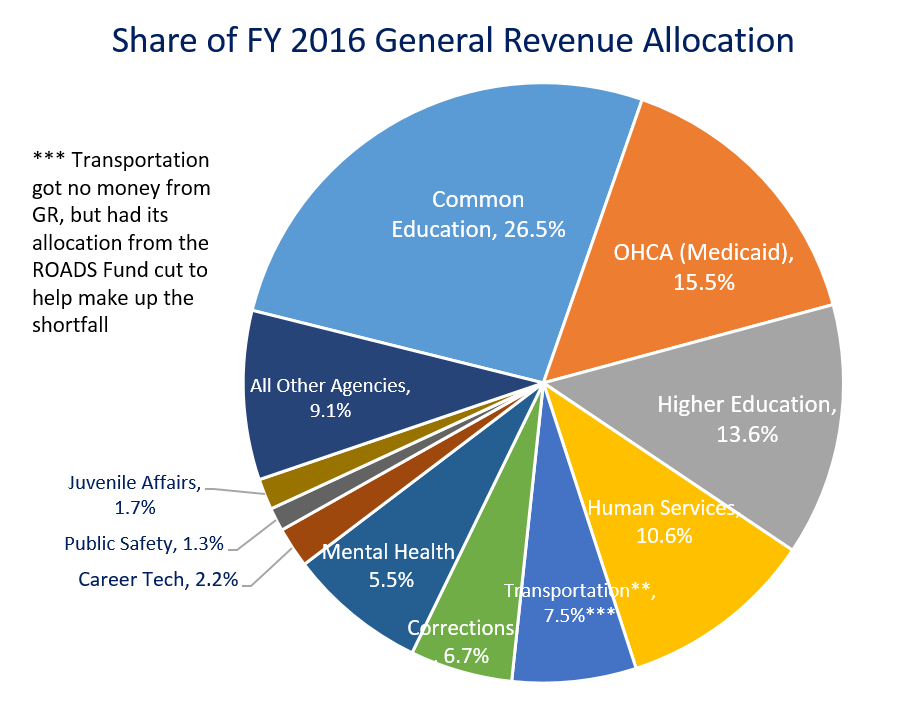
There does not seem to be clear rules for what to do when mid-year cuts are made based on a revenue failure and revenues subsequently exceed the revised projections. When asked by The Oklahoman, Secretary Doerflinger said that it’s premature to talk about the surplus before the fiscal year ends. Presumably agencies will be rebated all or some of the surplus in proportion to the amount they were cut in FY 2016 (see chart above). This wouldn’t happen until after June revenue collections are announced in July. Alternately, a special session could be called to allow the Legislature to decide on how to allocate the surplus.
[pullquote]“These cuts created substantial hardship for state agencies and the clients they serve. DHS, for example, was forced to defer cash payments to low-income seniors and those with disabilities. The Department of Mental Health and Substance Abuse Services cut provider rates, deferred provider payments, and reduced services for over 70,000 clients with mental illness.”[/pullquote]
Lessons to learn
The puzzle here is why, if in mid-February the Board of Equalization projected a shortfall 1.6 percent greater than what was accounted for with the initial mid-year cuts, OMES chose to cut agencies by a further 4 percent in early March. These cuts created substantial hardship for state agencies and the clients they serve. DHS, for example, was forced to defer cash payments to low-income seniors and those with disabilities. The Department of Mental Health and Substance Abuse Services cut provider rates, deferred provider payments, and reduced services for over 70,000 clients with mental illness.
OMES was clearly looking to err on the safe side and to avoid at all costs a third revenue failure at the very end of the fiscal year if revenues continued to come up short. That caution is understandable. Yet as we got closer to the end of the year and a surplus became increasingly probable, OMES chose not to share this news, which could have been helpful to agency leaders in making budget decisions going into the new year. The OMES May revenue news release was silent about the looming surplus, focusing instead on the impact of tax credits for wind producers.
More importantly, the fact that OMES seems to have unilateral authority to decide the amount and timing of mid-year cuts, as well as what to do with surpluses if they cut too much, is problematic. Putting in place a formal process for managing revenue failures that includes greater input and oversight would be a worthy reform for legislators to consider next session.