OKPOLICY.ORG

 Camille Landry is a writer, activist, and social justice advocate who lives in Oklahoma City. This post is part of our “Neglected Oklahoma” series, which tells the stories of Oklahomans in situations where the basic necessities of life are hard to come by. These are real people and their stories are true (names have been changed to protect privacy).
“My brother is doing 11 years in the state penitentiary.” There’s more bitterness than grief in Caryn Louis’s voice. “It’s not just losing somebody you love. The prison system punishes the entire family in lots of ways. Every little thing that my brother needs to make it through his sentence costs money and most of this money comes out of the pockets of inmates’ families and friends,” Ms. Louis said. “The state is punishing the families of the people it locks up.”
It is a not-so-well-kept secret that corporations that service prisons and corrections agencies profit by shifting considerable expenses to inmates’ families. Inmates cannot pay these costs themselves. People who enter the criminal justice system are overwhelmingly poor. Two-thirds of the people detained in prisons report annual incomes under $12,000 prior to arrest. Prison jobs pay $14.45 per month. Portions of that sum are deducted for such things as child support payments and court costs.
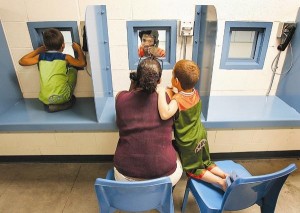 Research shows that family involvement helps combat recidivism and aids reintegration of offenders upon their release. It also results in calmer inmates — but the high costs associated with visits and phone calls puts them out of reach for many Inmates’ families. “My brother is a 3-hour drive away. I can only afford to see him a few times a year.” Most Oklahoma inmates come from Oklahoma and Tulsa counties and most of the correctional facilities are far away from those cities. “If you don’t have a good car and the money for a road trip, you just don’t get to visit,” she said.
“Phone calls,” Caryn said, “are such a ripoff. Inmates either call collect – and big charges are added to your phone bill, or you pre-pay for phone calls through a company that charges ridiculous amounts. People in jail or prison are not allowed to have cell phones or to use Skype or other free calling services and they can’t just pick up a phone and call.” The companies that handle phone calls for prisoners have funneled some of their profits into the prison system itself in “legalized kickbacks” that result in inmates’ families subsidizing part of the cost for incarceration of their loved ones.
Families must have a debit or credit card to use the system – another barrier to participation by poor families, many of whom do not have banking services or who pay high fees for use of alternative banking methods such as prepaid debit cards. “We even help to feed him. Prison food is awful and portions are small. Most people in prison buy extra food at the canteen – but a packet of noodles that costs a dollar at the grocery store is three bucks at the canteen.”
Inmates must purchase their own toiletries and personal grooming supplies. Deodorant, toothpaste, soap, lotion, hair products, toothbrushes, emery boards, tampons – things that most people take for granted – are heavily marked up compared to standard retail prices. DOC regulations allow these items to be procured only from the commissary. Families also bear the costs of college-level classes or training programs for their inmates.
DOC facilities for men do not have air conditioning. Inmates can purchase small fans. Radios and televisions are also for sale in the canteen – all at prices significantly higher than retail. “It costs money to send money to the prison,” Caryn said. “The State doesn’t accept money orders. We have to use one of the online prison bank systems.” The DOC receives a kickback from these fees.
 Families have to provide other items for their incarcerated loved ones. Oklahoma DOC provides shoes only up to size 12. If your feet are larger than that, you have to buy your own shoes or make do with flip flops, even in the winter time. “My brother is a big man with big feet. We paid $85 for a pair of sneakers that sell for $32 at Payless here in the city.” Inmates also purchase paper, stamps, envelopes and pencils to write letters.
Oklahoma spends the least in the nation on inmate medical care while passing on some of the costs to incarcerated people and those who support them. An inmate who has a headache or upset stomach pays $2.00 to see a nurse and receive medication, including standard over-the-counter remedies, for which they pay another $2.00 per dose. If a person doesn’t have money, DOC provides the medication or treatment and deducts its costs whenever money comes in from family or friends. Any treatment in excess of basic medical or dental service that the state covers has to be paid for by families. “I paid hundreds of dollars to have a crown replaced on a tooth that my brother broke,” Caryn said. “DOC wouldn’t fix it.”
“It’s not just my brother I have to help,” Caryn said. “He has two kids. I do as much as I can to help their mother.” Caryn’s nephews are not alone. Over 26,000 Oklahoma children have at least one parent in prison. Thousands more have a parent in a county jail or federal prison.
“They locked my brother away for 11 years. Our whole family pays for this, financially, emotionally, socially. We haven’t been convicted of anything but we’re up against the wall anyway – and people are profiting from our pain.”