OKPOLICY.ORG


This report was funded by a grant from the Anne and Henry Zarrow Foundation.
 Oklahoma’s tough-on-crime criminal justice ethos results in one of the highest per-capita incarceration rates in the US. Thousands of these incarcerated Oklahomans are released to the streets every year, but when they are released, many ex-offenders have nowhere to live.
A new issue brief from Oklahoma Policy Institute discusses barriers to affordable housing for Oklahomans with felony convictions; details what those barriers mean for ex-felons and their families; and shares models used by other states and localities to effectively use housing to decrease homelessness and recidivism and strengthen families.
Affordable housing in Oklahoma
The major public assistance for Americans to obtain housing comes through the US Department of Housing and Urban Development (HUD). The two primary HUD programs are public housing, where approved applicants live in residences owned by the local public housing authority (PHA), and Section 8 Housing Choice, which grants vouchers to approved applicants for paying rent to participating private housing developments. HUD requires local housing authorities to ban lifetime registered sex offenders and those convicted of certain drug-related crimes, and housing authorities have latitude to further restrict eligibility.
The Tulsa Housing Authority (THA), Oklahoma City Housing Authority (OCHA), and the Oklahoma Housing Finance Agency (OHFA) cover Tulsa, Oklahoma City, and rural parts of the state, respectively. Administrative documents provided by these agencies revealed that they exercize even more restrictive eligibility criteria than what is listed on their websites. THA and OHFA, for instance, may consider a pattern of arrests – regardless of conviction – to be sufficient criminal activity to ban an applicant household. The poorly disclosed and inconsistent pattern of restrictions by these agencies may cause Oklahomans with a criminal records to not apply for housing assistance, even when they would have been eligible.
Impacts of restrictions
Of the three PHAs surveyed, two could provide data on how many applicant households had been denied housing assistance due to criminal records. The Oklahoma Housing Finance Agency reported that 6 percent of all applicants were denied due to violent crimes or drug crimes, and the Tulsa Housing Authority reported that 13 percent of applicants were denied because they “did not meet” the criminal background screening.
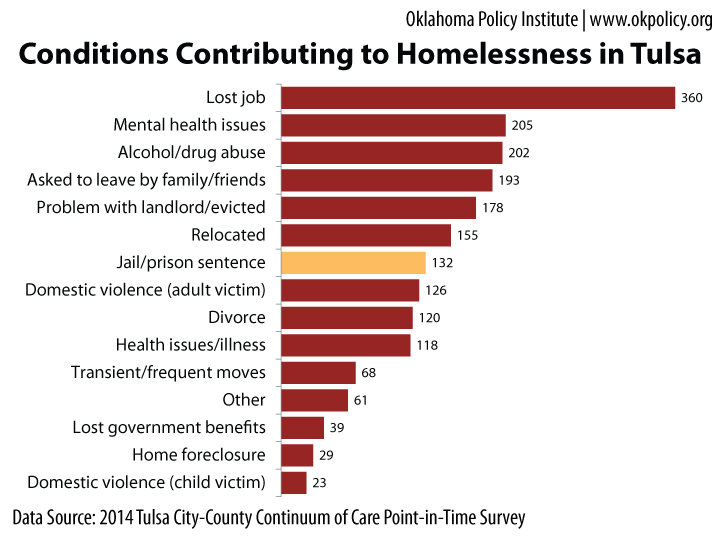 With limited data, it is difficult to estimate the effects of PHA housing restrictions on ex-felons. However, point-in-time homelessness surveys in Tulsa and Oklahoma City indicated that people with criminal records are overrepresented in the homeless population. In Tulsa, 12.3 percent of those surveyed said that jail or prison time had contributed toward their becoming homelessness, and in Oklahoma City, 18 percent reported having spent time in jail in the prior 6 months, and 9 percent had spent time in prison in the same time period.
Similarly, many organizations that provide support to those recently released from jail or prison said that locating housing was a significant barrier for their clients. One reported that clients often resort to living with people they were close to prior to their arrest and conviction – people who were frequently contributors towards the activities that led to incarceration in the first place. Another said that living with friends and family frequently came with conditions, such as providing child care, which impeded clients’ ability to locate and hold a job.
Barriers to housing are just one part of a web of challenges facing Oklahomans with felony convictions. The requirement that households may receive housing assistance only if they exclude household members with criminal records adds to incarceration’s disruption of the family. At the same time, those with felony convictions are barred from many jobs, some public safety net programs, and in some cases from obtaining a driver’s license. While policies designed to keep other families receiving housing assistance safe are important, they often go beyond what is necessary to protect safety and instead become more retribution after individuals have served their sentences.
Moving forward
Several major US cities, including some in politically conservative states, have implemented reforms to provide stable housing to residents with a felony conviction. Salt Lake City and County have partnered to implement “housing first” policies designed to move both the chronically homeless and recently-released prisoners into supportive housing. The Housing Authority of New Orleans recently revised their criminal background policy to allow housing assistance to all but the most heinous offenders.
Similar reforms are possible in Oklahoma. Legislation signed into law in the state’s 2015 legislative session reduces some of the restrictions have previously prevented Oklahomans with criminal records access to jobs to help them rebuild their lives after release: HB 2168 eases restrictions on obtaining job licenses, and HB 2179 allows nonviolent offenders on probation to obtain a commercial driver’s license.
Reforming housing policies and transitioning to a model that prioritizes housing for ex-offenders would fight recidivism, support the economy, and encourage stable families. These reforms should be an integral part of further criminal justice reform in Oklahoma.