




 OKPOLICY.ORG
The 2026 Oklahoma legislative session saw disappointingly few needed criminal justice reforms become law. Over the past few years, the legislature and the governor have built momentum for positive criminal justice reforms, but those efforts fell flat this year. Between self-imposed budget constraints, interchamber feuds, and the looming pressures of election season, there was relatively little appetite for major reforms to pass. In the end, Oklahoma saw little movement either forward or backward. Oklahomans deserve bold reforms, and lawmakers should prioritize delivering them in the next session.
Some smaller, but not insignificant measures passed this year
In the decade since voters passed significant criminal justice reform through State Questions 780 and 781, Oklahoma’s lawmakers have continued to take steps to reduce the state’s high incarceration rates and limit the collateral impacts of justice-system involvement. There is still much room for improvement, but nevertheless, small wins should be celebrated.
One area that saw small but important advancement this year was fines and fees reform. Justice-involved people are charged numerous fees in addition to the punishment they receive. These fees can add up to tens of thousands of dollars that many Oklahomans simply cannot afford to pay. To help address this, the legislature passed House Bill 4237 by Rep. Chris Kannady, R-Oklahoma City, and Sen. Todd Gollihare, R-Kellyville. This bill will allow people to have their ability to pay their fees assessed at their sentencing hearing and help clarify how judges should determine that ability. These changes will help ensure that justice-involved people aren’t needlessly saddled with debt they cannot repay. This also makes the process more efficient for court employees, judges, and defendants alike.
Another positive fines and fees bill that became law is HB 3321 by Rep. Mike Osburn, R-Edmond, and Sen. Gollihare. This bill will help provide policymakers with important state data about cost arrests – the practice of arresting people who owe outstanding fines and fees. This practice is expensive and ineffective. Although the state has mostly stopped making these arrests, they still occur occasionally and are hard to track. HB 3321 directs various agencies, such as county sheriffs and courts, to report data on the number and costs of these arrests so policymakers can make more informed decisions about when, or if, such arrests should occur.
Legislators also passed Senate Bill 1213 by Sen. Dave Rader, R-Tulsa, and Rep. Erick Harris, R-Edmond, which will help some incarcerated people accrue more earned time credits to reduce people’s sentences for good behavior. This bill also specifies that people incarcerated in jails are eligible for earned time credits while they await transfer to prison. Further, lawmakers passed SB 1636 by Sen. Carri Hicks, D-Oklahoma City, and Rep. Ross Ford, R-Broken Arrow, which addresses unsolved violent crimes, commonly known as cold cases. This bill allows victims’ families to request that law enforcement agencies assign someone who has not previously worked on the case to review their loved ones’ files. A fresh perspective could help uncover new leads and hopefully lead to more cases being solved. While this process is available to all families of cold case victims, it could be especially helpful for families of Missing and Murdered Indigenous People. These cases, especially those involving indigenous women, have been historically under-investigated by law enforcement agencies in Oklahoma and across the country.
Bad things passed or made it far this year
This year, the legislature advanced several bills harmful to Oklahoma’s criminal justice system. While many of these bills did not become law, their advancement nonetheless signals a potential return to harmful tough on crime approaches to public safety. One bill that became law is HB 3262 by Rep. John George, R-Newalla, and Sen. Kelly Hines, R-Oklahoma City, which increases the maximum sheriff’s service fee from $50 in adult cases and $20 in juvenile cases to $100 in both. This is one of a handful of fees involving the sheriff’s department that can be sent to a private debt collection agency if unpaid. In these cases, debt collectors can tack on additional charges to the money they collect and split the proceeds with the Oklahoma Sheriffs’ Association. Involving private debt collection agencies in the collection of fines and fees not only increases the amount of money people must pay but also opens the door to predatory debt collection practices, such as those alleged in an ongoing federal lawsuit. Gov. Kevin Stitt could have vetoed this bill, in keeping with his years-long fight against Oklahoma’s unfair fines and fees system, but he allowed it to become law without his signature.
The legislature nearly passed another bill that would have undone important voter-approved criminal justice reforms, but the Senate did not vote on the bill before adjourning. HB 4106 by Rep. Ross Ford, R-Broken Arrow, and Sen. Avery Frix, R-Muskogee, would have decreased the felony threshold for larceny, or theft, from $1,000 to $900 and implemented a three-strikes system for thefts totaling $900 if committed within 90 days. Through SQ 780, voters raised the felony larceny threshold from $500 to $1,000, which helped reduce the number of people Oklahoma imprisons for nonviolent, low-level crimes. Importantly, this change had no impact on the rate of larceny in Oklahoma. Hopefully, lawmakers will stop trying to roll back SQ 780 and instead advance measures to build upon previous reforms.
The legislature missed the mark on passing big reforms this year and needs to bring them back next year
Next year, the legislature should prioritize building upon past wins and passing major reforms. One area the legislature should prioritize is eliminating more fees charged to justice-involved people and expanding opportunities for people to have their court debt waived if they are unable to pay. In 2025, the legislature eliminated several fees from statute. This change stopped millions of dollars from being unfairly charged to people in the justice system. This was an important first step toward making the system more equitable, but there is still more work to do. While lawmakers introduced similar legislation this year, like HB 4112 by Rep. Tammy West, R-Oklahoma City, and Sen. Gollihare, the legislature did not reduce or eliminate court fees this year. This was in part due to budget constraints the legislature has imposed on itself through reducing revenue with repeated tax cuts and budget allocations that prioritize short-term political wins over long-term solutions.
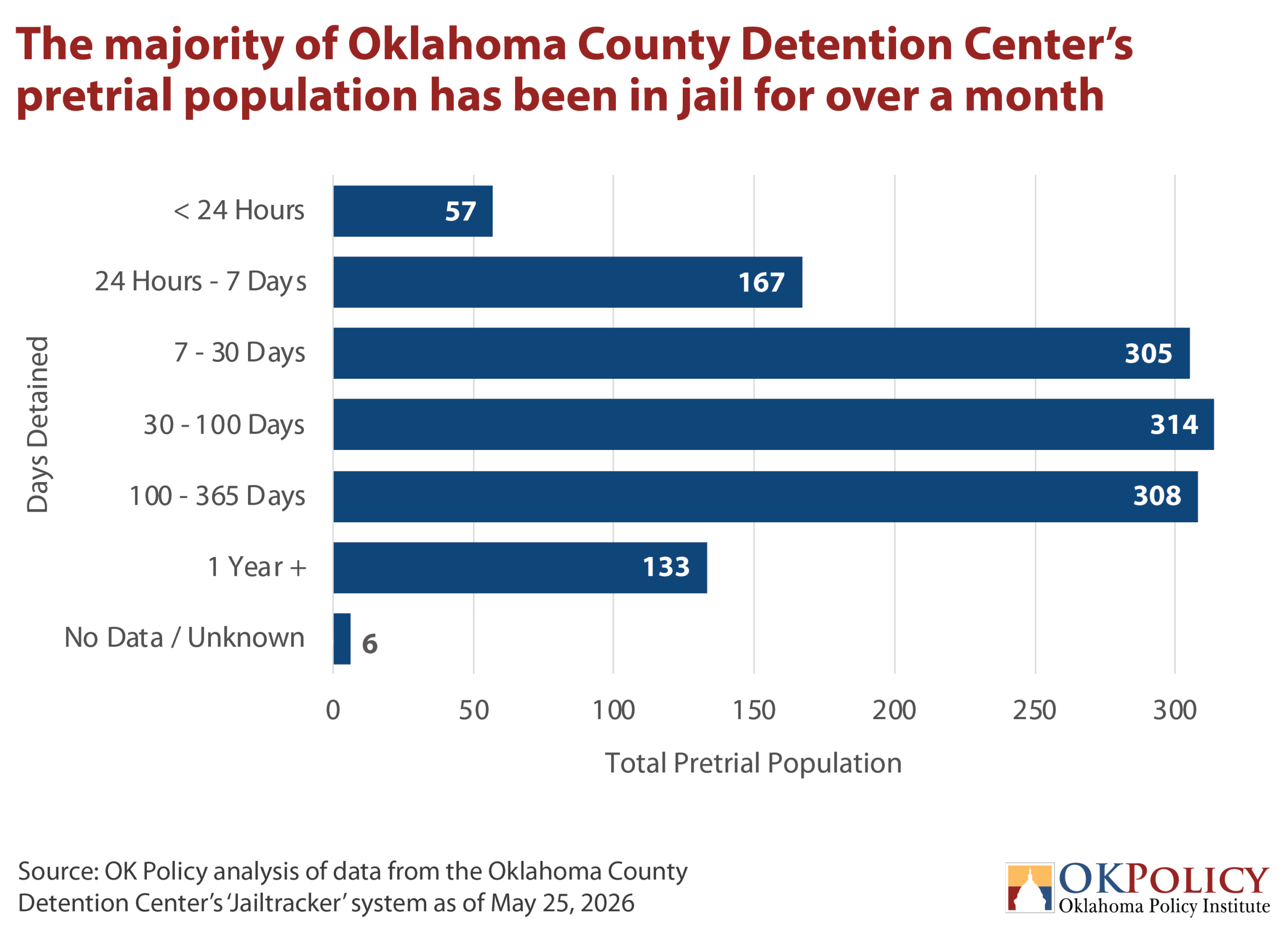
Another area in need of meaningful reform is the pretrial process. Oklahoma’s pretrial process is slow-moving and punishes poverty through its overreliance on cash bail. As a result, many jails, such as the Oklahoma County Detention Center, are full of people who have been incarcerated for months without being found guilty of a crime. Lawmakers had the opportunity to pass SB 1381, introduced by Sen. Rader and Rep. Harris, but failed to do so. This bill would have created a pilot program in Oklahoma County to provide everyone with legal representation at their bail hearing. It would also have established standards for judges to use when assessing bail. These changes would have helped ensure people are not unfairly kept in jail simply because they are too poor to afford bail. Unfortunately, the legislature did not pass SB 1381. Oklahoma’s pretrial process remains one of the most-needed areas of reform.
Finally, lawmakers should prioritize modernizing Oklahoma’s parole process to help reduce Oklahoma’s incarceration rate, which remains among the nation’s highest. One area that needs attention is the aging prisoner parole process. Oklahoma’s prison population is becoming progressively older as people who were sentenced to decades or life in prison in their youth continue to age. Costs of incarceration increase dramatically as people get older due largely to medical issues. Oklahoma’s existing process for granting parole to older incarcerated adults has seen little use and cannot meet the growing need to safely reduce our prisons’ aging population. HB 3053 by Rep. Ron Stewart, D-Tulsa, and Sen. Rader, and SB 1244 by Sen. Rader and Rep. Osburn were introduced this year to increase eligibility for this parole process. Neither bill advanced out of their chambers of origin. To address this growing need, lawmakers should consider hosting an interim study or directing the Legislative Office of Fiscal Transparency to author a report on the best ways to improve the state’s aging prisoner parole process.
Big problems require big solutions, and lawmakers missed the mark this year
Criminal justice remains an important issue for all Oklahoma voters regardless of political affiliation, and it’s an area with significant room for improvement. Unfortunately, the legislature missed the mark in 2026 by failing to pass many meaningful reforms. The smaller changes made will help reduce Oklahoma’s incarceration rate, but they are not enough to solve our overincarceration problem. While the lack of major wins and the advancement of harmful legislation are certainly disappointing, the fact remains that lawmakers have the opportunity to do better next year. To do so, however, the legislature must prioritize passing needed legislation over continuing its practice of slashing the budget and investing in policies that benefit the wealthy at the expense of everyday Oklahomans. Instead, lawmakers should seek to build on reforms that have had proven success. Half-measures are not enough to solve our problems, and Oklahoma’s lawmakers should stop believing that they will.