



 OKPOLICY.ORG
Every law passed in Oklahoma impacts Indian Country. With 39 Tribal Nations calling our state home, public policy does not exist in isolation from Tribal governments. Decisions made at the Oklahoma Capitol shape education systems, economic developments, and other areas across Native communities.
The Oklahoma Legislature has an opportunity this session to strengthen relationships with Tribal Nations through thoughtful policy in education and gaming. When the state works with Tribal Nations instead of around them, the benefits extend far beyond Tribal citizens. Strong Tribal–State partnerships support local economies, improve public safety, and expand opportunities for communities across Oklahoma.
Tribal consultation strengthens Oklahoma’s educational funding and outcomes
Education policy is one of the clearest examples of how collaboration between the state and Tribal Nations improves outcomes for everyone. Senate Bill 1721 by Sen. Ally Seifried, R-Claremore, would extend the sunset date for the Oklahoma Advisory Council on Indian Education (OACIE) from July 1, 2026, to July 1, 2029.
| Legislation | Author | Where is it in the legislative process (as of publication date) |
| SB 1721 | Sen. Ally Seifreid (R-Claremore) | Passed the Senate; sent to the House |
OACIE advises the Oklahoma State Department of Education on policies affecting Native students and helps ensure compliance with federal laws, including the Indian Education Act and the Johnson-O’Malley Act. Just as important, OACIE serves as a formal consultation pathway between Tribal Nations, school districts, and the state.
This work is particularly important in Oklahoma. Our state educates the second-largest Native student population in the country. Policies that affect Native students must be informed by meaningful consultation with Tribal Nations and Indigenous communities. 401 school districts in Oklahoma receive $29.6 million in federal grants through the Indian Education Act Grant Formula program alone to support Native students.
Federal regulations require that recipients of these grants meaningfully collaborate with Tribal Nations. While OACIE is not the only mechanism that could constitute meaningful consultation, maintaining structures like OACIE that formalize consultation and accountability demonstrates to federal partners that Oklahoma takes Tribal engagement seriously. It also provides a model of consultation and cooperation between the state and Tribal Nations for local school districts. In doing so, Oklahoma and our Tribal Nations position themselves to remain competitive for federal funding that supports students and school districts across the state.
Consultation also strengthens relationships between schools and Tribal Nations by creating a pathway of communication and collaboration that best serves Native children. Partnerships between Indigenous communities and the education system are vital to the success of Native students. Research consistently shows that stronger connections between Indigenous heritage, family support, and education systems can significantly improve learning outcomes for Native children. In a year when Oklahoma is focused on improving literacy among our young people, reinforcing systems such as OACIE and other partnerships between school systems and Tribal communities would help improve educational outcomes for students across our state.
Protecting Tribal gaming is a winning bet for Oklahoma’s economy
Gaming policy is another area where the state should strengthen partnerships with tribes to protect and improve local economies and support shared services. SB 1589 by House Speaker Rep. Kyle Hilbert, R-Bristow, Sen. Todd Gollihare, R-Kellyville, and Rep. Scott Fetgatter, R-Okmulgee, addresses a growing issue in Oklahoma by closing loopholes related to online casinos, gambling apps, and offshore gaming websites. At the same time, House Bill 1047 by Sen. Bill Coleman, R-Ponca City, and Rep. Ken Luttrell, R-Ponca City, outlines a potential framework for a new gaming compact that could allow online sports betting while maintaining the tribal exclusivity that has long governed gaming in Oklahoma.
| Legislation | Author | Where is it in the legislative process (as of publication date) |
|
House Speaker Kyle Hilbert (R-Bristow), Sen. Todd Gollihare (R-Kellyville), & Rep.Scott Fettgatter (R-Okmulgee) |
Passed the Senate; sent to the House |
|
|
Sen. Bill Coleman (R-Ponca City) & Rep. Ken Luttrell (R-Ponca City) |
Pending negotiations between the state and Tribes |
The companies benefiting from Oklahoma’s current loophole are not local operators but offshore companies that solicit U.S. customers without Oklahoma licensure or consumer protection. The loopholes these companies exploit are grey areas in Oklahoma gaming law: operating outside its jurisdiction and using cryptocurrency and/or in-game currency.
These online casinos have raised legal concerns from 50 state and territory attorneys general across the country. This includes Oklahoma’s Attorney General Gentner Drummond, who signed onto a letter requesting that the U.S. Department of Justice investigate these online, offshore casinos. The letter additionally requests that the department enforce federal law that likely renders them illegal. By closing these loopholes under Oklahoma law, we increase the likelihood that federal officers can prosecute these companies. since federal gambling laws explicitly require compliance with state gambling laws. While there is no precise public estimate of how many Oklahomans use these sites, national online traffic data shows they attract millions of visits each month: recent market research by the American Gaming Association found that 76 percent of respondents participated in illegal online table and slot games, and 46 percent reported taking part in illegal online sportsbetting. These statistics suggest a market of substantial scale and revenue. Even more troubling, many of these offshore operators target vulnerable populations while operating outside both state oversight and federal law, leaving many without the legal protections and accountable business practices standards that protect consumers under Oklahoma’s current casino models.
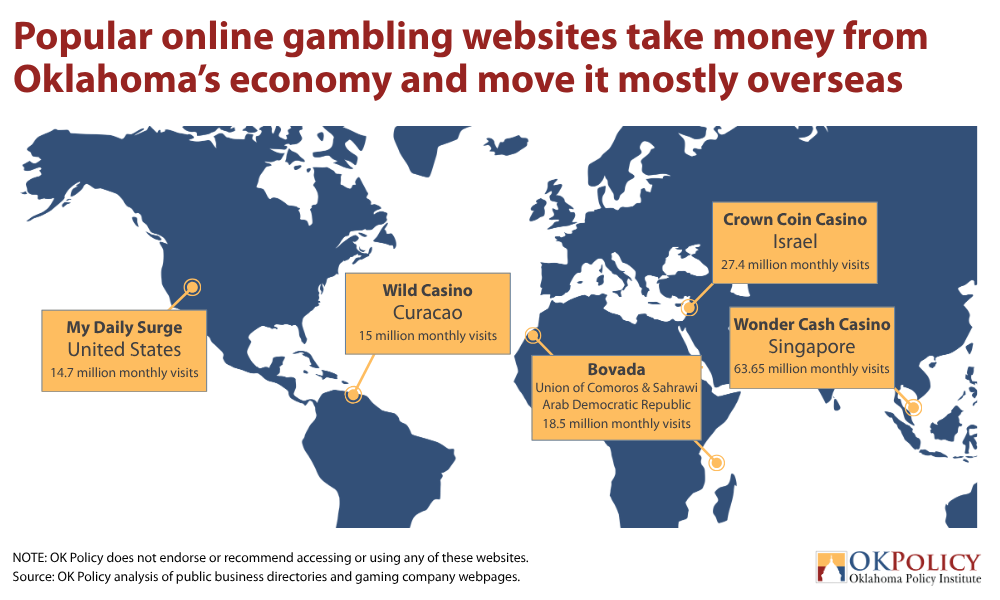
Popular Gaming Websites and their Country of Origin
| Website* | Monthly Traffic Visits (Feb 2026) | Type | Owning Company | Country of Origin |
| Crown Coin Casino | 27.4 million | Slots | Sunflower Limited | Israel |
| Bovada | 18.46 million | Sports Betting, Slots, and Table Games | Central Reserve Authority of the Western Sahara | Union of Comoros & Sahrawi Arab Democratic Republic |
| Wonder Cash Casino | 63.65 million | Slots | Century Games | Singapore |
| Wild Casino | 15 million | Table Games and Slots | Dama N.V. | Curacao |
| My Daily Surge | 14.7 million | Sweepstakes | My Daily Surge | United States |
*Oklahoma Policy Institute does not endorse or recommend accessing or using any of these websites.
Closing these loopholes and maintaining Tribal exclusivity in online gaming matters for Oklahoma’s economy. When voters approved Tribal gaming compacts in 2004, the goal was to generate local revenue and jobs while strengthening Oklahoma’s communities. Allowing outside companies to compete in the state’s gambling market risks shifting that revenue away from local communities and toward shady offshore corporations, without any of the benefits that Tribal gaming has brought to Oklahoma.
Under the federal Indian Gaming Regulatory Act, Tribal gaming revenue must be reinvested in Tribal government services, economic development, and community programs. Profits are not distributed to outside shareholders. Instead, revenues support Oklahoma’s education, health care, housing, infrastructure, and employment in communities across our state.
The economic impact of Tribal gaming has been substantial. In Oklahoma fiscal year 2025, Tribal revenue from state-compacted gaming totaled $3.64 billion. Of that amount, Tribes paid more than $221 million in exclusivity fees to the state. Since 2005, Tribal gaming exclusivity fees have contributed more than $2.33 billion to Oklahoma’s Education Reform Revolving Fund (1017 Fund), accounting for roughly $1 in every $3 of Oklahoma’s public education funding statewide. That’s in addition to the many direct investments tribes make in local schools, infrastructure, and community development: in 2023 alone, tribal governments contributed more than $351 million to education, $582 million to health care services, and over $7.8 billion in wages and benefits across Oklahoma. As Oklahoma started this session with a budget shortfall once again, Oklahoma must preserve and increase our revenue sources. By passing HB 1047 and SB 1589, Oklahoma recommits to its most reliable economic partner — the 39 Tribal Nations that call Oklahoma home and have a massive stake in making sure that Oklahoma thrives.
When Tribal Nations thrive, so do all Oklahomans
Policies that support consultation in education and protect tribal economic investments demonstrate what an effective partnership can look like. When the state and Tribes work together, the result is stronger communities, healthier economies, and better outcomes for all Oklahomans. As lawmakers consider bills affecting education and gaming this session, maintaining strong tribal-state partnerships will be critical to protecting both economic stability and educational opportunity across Oklahoma. Building and maintaining those partnerships between Oklahoma and the 39 Tribal Nations that share this land should remain a priority for the rest of the legislative session and beyond.