OKPOLICY.ORG

COVID-19 Policy Analysis: As our nation confronts the COVID-19 pandemic, OK Policy will be analyzing state and federal policies that impact our state and its residents during this national health emergency. These posts reflect the most current information available at publication, and we will update or publish follow-ups as new information becomes available.
NOTE: OK Policy is not a state agency and we cannot assist in applying for state services or provide legal advice.
- For direct service assistance, please call 211 or visit the 211 website
- For unemployment, contact the Oklahoma Employment Security Commission
– – –
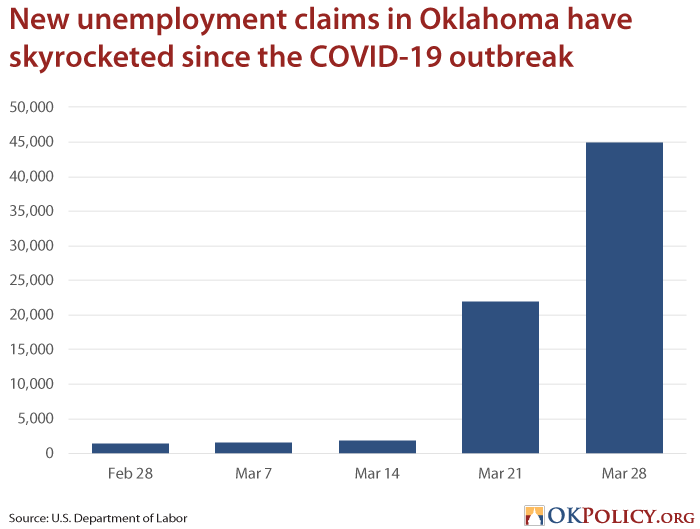
More than 6.6 million Americans filed initial claims for unemployment insurance during the week ending March 28, 2020, including 44,970 Oklahomans. That is an increase from the previous week, which saw initial claims of 3.3 million nationally and 21,926 in Oklahoma. These numbers are a new record for initial claims, both nationally and in our state. The previous record for national unemployment claims was set in October 1982 with 695,000 claims, so the past week’s claims are nearly 10 times the previous record. Job losses during the past two weeks all but eliminated the jobs created in the last five years. These two weeks of unemployment claims offer the first data on how the COVID-19 public health emergency is impacting the economy. Last week’s picture was grim, and it may be that way for a bit.
However, there is some good news. The CARES Act, passed recently by the federal government, includes a significant boost to unemployment insurance to help people who find themselves unable to work right now. Oklahoma could maximize the benefit of this relief package by reestablishing our work share program to better help workers who still have jobs, but with reduced hours.
Unemployment will be going up — a lot
With a record number of new claims filed in the week ending March 21 and even higher numbers the following week, we should be prepared for the unemployment rate to rise. The Economic Policy Institute estimates that Oklahoma will lose more than 200,000 jobs by July – that’s 15.7 percent of our total private-sector employment. Many of those jobs lost will be in the service and hospitality industries, and these workers will not be able to quickly find new jobs.
Unemployment will go up, and it is likely to remain high throughout the summer. The national unemployment rate was 3.5 percent in February before the virus outbreak hit the U.S. Although current figures have not been published, estimates place the national unemployment rate right now between 10 and 13 percent. By comparison, the unemployment rate during the Great Recession was about 10 percent in 2009, while it was about 25 percent in 1933 during the height of the Great Depression. Some forecasters have projected we could see the national unemployment rate reach 30 percent.
The CARES Act will provide expanded unemployment benefits for more workers
The federal CARES Act will provide a boost for the unemployment insurance system to help sustain workers until the economy begins to recover. The bill creates three new temporary benefits, all funded by the federal government.
Pandemic Unemployment Compensation (PUC)
From March 27 until July 30, all unemployment insurance beneficiaries will receive their usual weekly benefit and an additional $600 per week. This additional benefit is a flat amount, and the full amount will be given to all claimants regardless of whether they are fully or partially unemployed.
Pandemic Emergency Unemployment Compensation (PEUC)
An additional 13 weeks of benefits will be available after an individual exhausts their regular unemployment benefits. In Oklahoma, the maximum number of weeks for regular unemployment insurance benefits is 26. This additional 13 weeks will bring the maximum up to 39 weeks.
Pandemic Unemployment Assistance (PUA)
This new program will provide unemployment benefits to individuals who would not normally qualify for state unemployment compensation. This includes the self-employed, independent contractors, anyone seeking part-time work, and workers who do not have a long enough work history to qualify for state unemployment benefits. Applicants will need to demonstrate they are unemployed, or unable to work due to the pandemic. Workers are not eligible for PUA if they are able to remotely work with pay or are receiving paid leave. Workers will be retroactively eligible for up to 39 weeks of PUA, and the program will expire at the end of this year.
Oklahoma could restart our work share program to better cover workers with reduced hours
In addition to these three new benefits, the CARES Act also provides federal funding for work share programs. In states with work share programs, employers can avoid lay-offs by placing workers on part-time work schedules. Affected workers can then collect partial unemployment benefits to recoup some of their lost income. In the case of work share, the employer submits the documentation for all affected workers, and the employees do not have to submit individual claims for unemployment benefits.
Under the CARES Act, the federal government will finance 100 percent of work share benefits in states that already have such programs. Unfortunately, Oklahoma is not one of these states. The state previously had a work share program, but it was repealed in 2014. Now would be an opportune time to restart the program — the CARES Act includes grants to states that wish to create work share programs to offset the costs of establishing such a program. The federal government will fund 50 percent of those benefits for the remainder of the year. Work share programs are good for business and for workers, and Oklahoma should take this opportunity to reestablish our program while federal support is available.