OKPOLICY.ORG

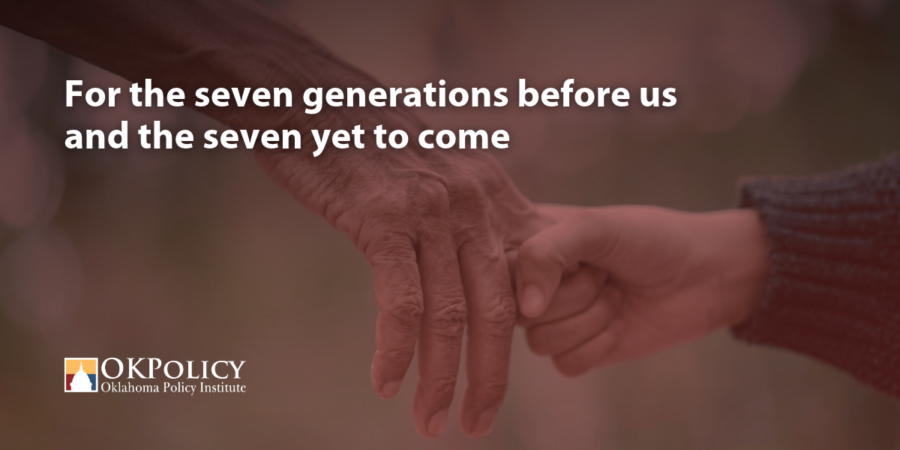
We often take the history, policy decisions, and sacrifices of those who came before us for granted, as if the world they shaped is simply the way things are. But that history impacts us every day. In many Native communities, including my own in the Cherokee Nation, we are taught to consider how the decisions we make today will affect the next seven generations while honoring the sacrifices of the generations who came before us. That leadership lesson is worth taking to heart, particularly in public policy, where the decisions we make today can shape lives for generations.
This principle of Seven Generations is found in many Native Nations’ traditions today and is attributed as one of the teachings of the Haudenosaunee, as described in their lesson on how their Confederacy and Great Law of Peace came to be. Today, this commitment to future generations is also reflected in the Cherokee Nation’s mission statement:
“The Cherokee Nation is committed to protecting our inherent sovereignty, preserving and promoting Cherokee culture, language, and values, and improving the quality of life for the next seven generations of Cherokee Nation citizens.”
At its core, this teaching asks us to consider the long-term consequences of our decisions for those who will come after us. This teaching also calls us to look backward when making policy decisions. That means honoring the sacrifices and love of those who came before us while still reckoning with the harm they may have caused, rejecting the beliefs and actions that perpetuated that harm, and recognizing how their choices continue to shape our lives today.
It is less comfortable to think about the ways those who came before were wrong, but also often just as, if not more, important for creating better policy for the next seven generations. Take, for example, that the 1907 Oklahoma Constitution guaranteed public schooling for all children in Oklahoma, including for blind and deaf children, but in the very next section outlined the separation of Black children from “white” children. There is nuance to the fact that Oklahoma had — and arguably still has — one of the most progressive Constitutions, despite the fact it was created by many men whose first legislative bill would be to introduce segregation into the laws of this state. Does that mean we need to throw out the whole Oklahoma Constitution and the laws of Oklahoma? No, but it does mean we have to acknowledge and actively work to repair the harm those ancestral leaders of our state have left us with. Importantly, our elected leaders today have often acted to repair these harms through bills like 2024’s Senate Bill 1617, which allowed cities to begin removing racial discrimination from land covenants.
It should also serve as a lesson to today’s leaders that, while they work to fix the problems of the past, they should not create preventable problems for the next seven generations of Oklahoma leaders.
In the 2026 legislative session, Oklahoma lawmakers considered proposals targeting minority communities that seemed designed for the politics of the moment rather than the long-term well-being of our state. This quick-and-easy win model of governance has never been more apparent than today, when legislators have finite time in office due to term limits. Legislators no longer have to answer to the public when the long-term effects of their policies come knocking. Too often, the incentives of short-term politics reward culture-war rhetoric and powerful interests over the slower work of cultivating policies that serve Oklahomans for generations.
This is clearest when it comes to our tax policy in Oklahoma. We often tout tax cuts on sales, property, or income taxes, even as we can see the suffering of the less fortunate in our state and the ongoing effects of inadequate funding on the well-being of our young people. These policies to cut taxes rarely, if ever, consider the long-term effects on the generation before us, our elderly, and our veterans, who need better care options, or the generations coming after us, who need to be born in hospitals and attend schools in their local communities, not two hours away. Surely the hope of the seven generations who came before us was that our lives and the lives of our children would be better than theirs. We should ask whether a tax policy that weakens schools, hospitals, care for older Oklahomans, or other public services honors that hope. The path to a better Oklahoma will not come from starving the budgets of our state services, but from investing in the generations ahead of us and honoring the lives of those who have come before us and sacrificed for us.
My time at Oklahoma Policy reinforced my belief that good policy requires us to think beyond the next election, the next legislative session, or even our own lifetimes. Even after leaving this organization and Oklahoma to begin my next chapter, I hope to leave behind this message of hope for a better Oklahoma through reflecting on our history and looking towards our future. As Dr. Martin Luther King, Jr., reminds us, “the arc of the moral universe is long, but it bends towards justice.” So while I encourage today’s leaders to reckon with the harm discriminatory and short-sighted policies have caused, I remain hopeful because history does not end with us. We have an obligation to leave the next seven generations with fewer harms to repair, stronger communities to inherit, and a better Oklahoma to call home.