



 OKPOLICY.ORG
Tribal Nations are the backbone of Oklahoma, and it’s time for state leaders to act like it.
Tribal governments existed before statehood, before Oklahoma’s borders were drawn, and before state leaders claimed authority over this land. Tribes are not special interest groups. They are not temporary political actors. They are Sovereign Nations with responsibilities to their citizens and communities.
A 2025 report concluded that Oklahoma Tribal Nations contributed $23.4 billion to the state’s economy, supported 139,860 jobs, and generated more than $7.8 billion in wages and benefits for Oklahoma workers. That means paychecks, hospital visits, scholarships, roads, housing, small-business contracts, and public services Oklahomans rely on every day.
Tribal Nations are among Oklahoma’s largest employers, health care providers, education partners, infrastructure builders, and economic drivers. Yet for the last decade, too many state leaders, especially the Oklahoma Governor, have treated Tribal Sovereignty as a threat instead of one of Oklahoma’s greatest strengths.
Oklahomans now have a choice this November. We can continue treating Tribal Nations like political obstacles, or we can elect leaders who recognize Tribal partnership for what it is: one of the strongest assets this state has.
Tribal Nations do not need Oklahoma. Oklahoma needs the Tribes.
Corporations will leave Oklahoma if another state offers a better tax deal. A new governor will be elected every 4-8 years, and the pendulum of political power in the Legislature will swing, but Tribal Nations are here and will remain here, ready to build a better Oklahoma. The interests of our 39 Tribal Nations lie in investing in our communities, because a more educated, healthier, and safer Oklahoma benefits everyone who calls our state home, whether or not they are Tribal citizens.
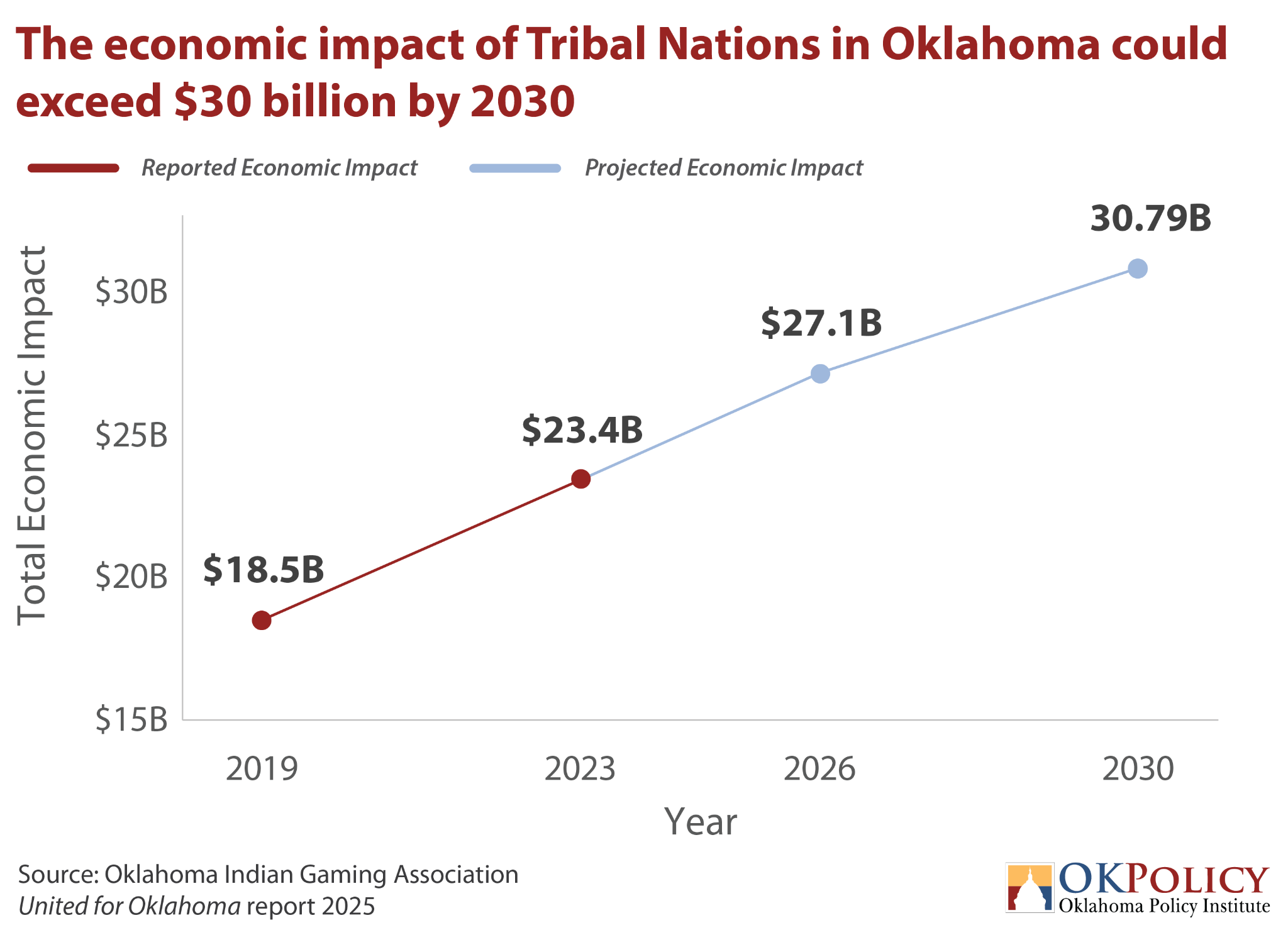
Tribal Nations are reliable, steadily growing economic engines in this state. Based on growth trends in United for Oklahoma’s economic impact reports, Tribal Nations’ current economic impact is likely even larger than the most recent statewide figure for 2023 of $23.4 billion. In 2019, Oklahoma Tribes contributed about $18.5 billion. By FY 2023, that impact had grown to $23.4 billion. If the growth trend from 2019-2023 continued, Tribal economic impact could reasonably be $27 billion today and could exceed $30 billion by 2030.
Gaming is one of the clearest examples of Tribal impact on the state economy. In 2025, the Tribes paid $221 million in gaming exclusivity fees to the state. Of that amount, $194.3 million went to the Education Reform Revolving Fund (1017 fund). In addition to that contribution to education, the Tribes spent $133.6 million on Tribal education programs and scholarships and donated an additional $39.3 million to Oklahoma communities and universities for education-related purposes. That is why the state’s approach to Tribal gaming, compact negotiations, and Tribal economic projects matters. Oklahoma should not be trying to weaken one of its strongest economic partnerships, as Tribal revenue does not disappear into distant corporate headquarters. Federal statute requires investment in health care, education, infrastructure, housing, language preservation, public safety, and economic development, ensuring that money stays here in Oklahoma.
With that commitment to Oklahoma’s future, at a minimum, state leaders should work with Tribes to protect legal, regulated Tribal gaming from offshore operators and other companies seeking access to Oklahoma’s market without the same investment in Oklahoma communities.
This session, the Legislature overrode a veto by the governor to support SB 1589, which closed loopholes in Oklahoma law that allowed foreign online casinos to operate in the state. These online casinos have diverted revenue that could have stayed here in Oklahoma and distributed it to shady offshore corporations without any tangible benefit to Oklahomans. By closing this loophole, Oklahoma will hopefully be able to keep more of that revenue here in the state.
Online casinos are not the only threat to Tribal gaming exclusivity in this state. Online Sports betting, which has grown in popularity over the last few years, is still illegal in Oklahoma. This session, we fell short yet again of reaching a deal between the state and the Tribes on sports betting, despite a proposal supported by the Oklahoma Indian Gaming Association in HB 1047. Legislators raised important points for and against this bill that a future agreement should consider. Oklahomans, native and non-native, deserve a deal between Oklahoma and Tribal Nations that balances the reality that sports betting is already here and happening illegally, while maintaining the practice of money from vices in Oklahoma being reinvested directly back into our communities.
Still, online sports betting poses greater risks to Oklahoma that must be weighed against the potential economic benefits. Just as Oklahomans did in 2004, when the majority voted for State Question 712 to enter into compacts with Tribal Nations that built our casino industry, it’s time for Oklahomans to again decide whether this risk is worth the reward. Importantly, Oklahomans should keep in mind that Tribal exclusivity in the gaming market should be maintained because Oklahoma’s Tribal Nations are the only gaming operators committed to reinvesting those profits back into our Oklahoma communities.
Oklahoma politicians constantly talk about wanting stronger rural communities, better schools, more jobs, and greater economic growth. However, Tribal Nations are the governments actually doing that work. The state’s top leaders should stop treating Tribal Sovereignty as an obstacle to Oklahoma’s success and instead acknowledge the tremendous economic activity and development that Tribal Nations have brought to the state.
Oklahoma is stronger when we work together.
Oklahoma has a built-in model of successful partnership between Native Tribes and the state: Tribal consultation. Meaningful Tribal consultation means bringing Tribal Nations into the conversation early; it means respecting Tribal expertise and understanding that policies affecting Native communities should not be written without Native governments at the table. It also means recognizing that Tribal-state cooperation often benefits everyone, not just Tribal citizens.
Oklahoma has more than 150,000 Native American students in public schools, which makes up about 15 percent of Oklahoma’s total public school population, one of the highest proportions in the country. That means Tribal consultation is not a side issue in Oklahoma education policy — it is central to whether our schools are serving students well. Unfortunately, this year, the Governor vetoed HB 3006 and SB 1721, which would have extended the Oklahoma Advisory Council on Indian Education. The Legislature failed to override these vetoes, ending a 16-year program that created a formal pathway for Tribal Nations to advise the state on policies affecting Native students. When Oklahoma loses these collaboration pathways, it is not only disrespecting Tribal Nations; it’s making education policy worse and putting federal education dollars at risk.
Tribal Nations also fill gaps in Oklahoma’s most essential public services. In health care, Tribes are not only treating patients today, but also building the workforce Oklahoma will need tomorrow. The Cherokee Nation is investing in a $30 million Nursing and Allied Health Education Center partnership with the University of Oklahoma, as well as a $5.15 million health scholarship endowment. It has further partnered with Oklahoma State University on the OSU College of Osteopathic Medicine at the Cherokee Nation, the first Tribally affiliated medical school on Tribal land in the country. These investments help train more doctors, nurses, and health care workers in rural Oklahoma, with the goal of keeping them in the communities that need them most.
That is why this session’s effort to repeal or weaken Medicaid expansion with HB 4440 and SJR50 was not just a health care fight. It was a Tribal-state consultation failure. Tribal leaders from the Inter-Tribal Council of the Five Tribes opposed efforts to move Medicaid expansion out of the Oklahoma Constitution and make it easier for lawmakers to cut coverage because the consequences would fall heavily on Native patients, rural hospitals, and Tribal health systems. Cherokee Nation Principal Chief Chuck Hoskin Jr. warned that rolling back expansion would disproportionately harm Native communities and could cost the Cherokee Nation alone more than $162 million.
Instead of treating that warning as expertise from the Tribal Nations that help carry Oklahoma’s health care system, House Speaker Kyle Hilbert barred Chief Hoskin from being invited back to speak on the Oklahoma House floor after Hoskin defended Medicaid expansion during his April 8 address. Hilbert said the House floor was not the right place for Hoskin to discuss concerns about the Legislature’s Medicaid proposal. Yet if the House floor is not the place for the leader of the largest Tribal Nation in the country to explain how state legislation affects his Nation, then the House Speaker needs to answer where, in the legislative process, the priorities of Tribal Nations are being heard. Throughout the next session, lawmakers should consult Tribal Nations before filing bills that affect Tribal citizens, Tribal health systems, Tribal revenue, or Tribal jurisdiction. Consultation after public backlash is not consultation; it’s damage control.
As the Legislature continues to seek revenue cuts through property and income tax reductions, Tribal Nations will be expected to fill the resulting gaps in services and investments.
The cracks in Oklahoma’s governance are already showing across our state. In Adair County, those cracks have become a public health emergency. After the county’s hospital closed and its EMS system reached a crisis point, the Cherokee Nation had to step in with $150,000 to help maintain a minimum level of ambulance service, even though the Cherokee Nation does not operate or fund Adair County EMS. That should alarm every lawmaker at the Capitol. The state cannot keep starving public services, weakening local revenue, and then quietly relying on Tribal Nations to rescue communities when basic systems fail. Rural Oklahomans should not have to depend on emergency Tribal intervention because state leaders refuse to fund the public infrastructure that keeps people alive. Next session, lawmakers need to stop touting tax cuts as harmless political wins and start accounting for whose lives will be on the line when Oklahoma’s counties, cities, hospitals, and emergency services are left without enough support.
Make no mistake: Tribal Nations will continue stepping in to help Oklahomans when state government fails them. That is what good governments do. But Tribal Nations should not be forced to subsidize reckless tax cuts, collapsing county services, and a state political culture that treats Tribal partnership as a convenience instead of a responsibility.
Oklahoma cannot afford another decade of conflict
The last several years have shown what happens when Tribal-state relationships are defined by conflict instead of cooperation. Under the current Governor, Oklahoma has seen repeated fights over gaming, tobacco, and motor vehicle compacts, as well as Tribal jurisdiction after McGirt v. Oklahoma. Too often, litigation replaced consultation, compromise, and good governance.
That approach has cost Oklahomans. A 2023 Legislative Office of Fiscal Transparency report found the state was on track to spend at least $3.3 million in legal fees tied to Tribal disputes. The Frontier reported in 2023 that more than $1.9 million had already been spent on outside legal fees related to gaming compact lawsuits, and in 2021, the Legislature set aside $10 million to fight Tribes in court over issues related to Tribal Sovereignty. That money could have supported schools, health care, public safety, rural infrastructure, or any number of services Oklahoma families actually need. Instead, state leaders used public dollars to undermine one of Oklahoma’s most important partnerships.
This session made the choice even clearer. On gaming, education, Medicaid expansion, and rural emergency services, Tribal Nations were not asking the state for special treatment. They were asking the state to respect existing partnerships, protect services that benefit Oklahomans, and consult with Tribal citizens and Tribal governments before making decisions that affect them.
The banning of Principal Chief Hoskin from future remarks on the House floor after he defended Medicaid expansion should not be treated as a one-day political story. It should be treated as a warning sign. Oklahoma cannot claim to value Tribal partnership while punishing Tribal leaders for explaining how state policy harms their people.
Tribal Nations have continued to invest in Oklahoma despite broken promises, political hostility, and state leaders who too often treat Tribal Sovereignty like an inconvenience. They have built hospitals, schools, businesses, roads, homes, cultural institutions, and public safety systems. They have created jobs, funded services, and supported Native and non-Native communities alike. Tribal Nations have never stopped showing up for Oklahoma.
Next session, Oklahoma’s leaders need to show up for the Tribes by consulting early, negotiating in good faith, reinstating formal advisory bodies such as the Oklahoma Advisory Council on Indian Education, respecting Tribal health systems, and ending the habit of turning every disagreement into a courtroom fight or a campaign talking point.
Oklahoma can keep wasting millions of taxpayer dollars fighting Tribal Nations in court, or it can work with the governments that contribute $23.4 billion to the state economy, support nearly 140,000 jobs, and deliver hundreds of millions of dollars for education each year. This should not be a difficult choice.
Oklahoma does not need to fear Tribal Sovereignty. It needs to stop undermining it.
Tribal Nations are not obstacles to Oklahoma’s future: they are one of the strongest reasons Oklahoma has a future worth building.